Star-Hopping & Sky Navigation: Finding Anything Without GoTo Computers
- Star-hopping is the art of stepping from unmistakable naked-eye 'signpost stars' across simple geometric triangles and lines straight onto faint planets, star clusters, and galaxies.
- Your own outstretched hand at arm's length is a precision calibrated angular ruler—measuring 1° (pinky), 5° (three fingers), 10° (clenched fist), and 25° (open thumb-to-pinky span) regardless of body height!
- Aligning your telescope's Red-Dot or 6×30 finder scope during daylight on a distant cell tower saves 90% of nighttime aiming frustration.
- Master just four anchor constellations—Ursa Major (Big Dipper), Orion, Cassiopeia, and Scorpius/Crux—to orient yourself anywhere on Earth in ten seconds.
Why Manual Star-Hopping Beats Cheap Computerized Scopes
Watch a veteran Dobsonian observer next to someone wrestling with an entry-level computerized GoTo tripod at a public star party: while the computer owner spends twenty minutes leveling legs, typing UTC offsets, re-doing failed 3-star alignments, and swapping dead AA battery packs, the manual observer has already shown guests Saturn, the Ring Nebula, the Andromeda Galaxy, and the Hercules Globular Cluster!
Once you learn Star-Hopping—treating bright naked-eye constellations like highway exits and stepping down local star-chain streets through your finder scope—you build a permanent mental map of the universe that never runs out of batteries and turns finding elusive targets like Uranus or Messier nebulae into a deeply rewarding treasure hunt.
Calibrating Your Outstretched Hand as an Angular Sky Ruler
In astronomy, linear distances like "two inches left" mean nothing—every sky distance on PlanetsTonight.com is measured in angular degrees (`°`), arcminutes (`'`, where `60' = 1°`), and arcseconds (`"`, where `3,600" = 1°`). Remarkably, human anatomy scales forearm length proportionally with hand width from childhood to tall adults—so holding your arm 100% locked straight out in front of your nose gives everyone the exact same sky ruler:
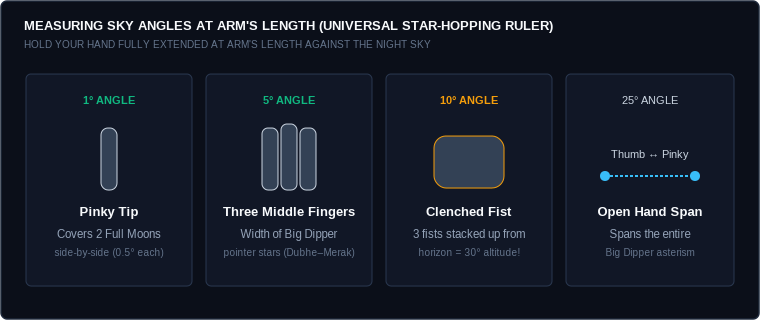
- `0.5°` (30 Arcminutes): The exact width of the Full Moon or Sun—easily covered with room to spare by half your pinky nail!
- `1°` Angle: Width of your outstretched pinky fingertip.
- `5°` Angle: Width across your three middle fingers pressed together—matching the `5.4°` gap between the Big Dipper's two front bowl "Pointer Stars" (Dubhe and Merak), and slightly narrower than a `6.0°–6.5°` field in 10×50 binoculars!
- `10°` Angle: Width across your clenched fist (knuckles horizontal for azimuth jumps, or fists stacked thumb-over-pinky vertically up from the horizon: `3 stacked fists = 30° altitude`; `9 fists = 90° zenith straight overhead`!).
- `25°` Angle: Fully splayed **"hang-loose" span from thumb tip to pinky tip**—almost the exact end-to-end length of the entire Big Dipper!
Four Universal Signpost Constellations & Classic Pointer Hops
You do not need to memorize all 88 official IAU constellations! Learn four bright anchor patterns and trace straight geometric laser lines off their edges:
| Anchor Pattern | Prime Seasons | Famous Geometric Pointer Hop |
|---|---|---|
| 1. The Big Dipper (Ursa Major) | Feb – Aug (N. Hem) | • Extend the two front bowl stars 5× northward (`~28°`) straight to Polaris (North Star · 0° Azimuth)! • Follow the curved Dipper handle: "Arc to Arcturus (bright orange Boötes star), then Spike south to Spica (Virgo)!" |
| 2. Orion the Hunter | Nov – Apr (Global!) | • Follow Orion's 3-star Belt down/southeast (`~20°`) straight to blazing Sirius (brightest star in the sky). • Follow Orion's Belt up/northwest (`~20°`) through orange Aldebaran right into the Pleiades (M45)! |
| 3. Cassiopeia ("The Queen's W") | Aug – Feb (N. Hem) | • Follow the shallower side of the "W" downward to Perseus to hit the Double Cluster. • Bisect the sharper, deeper "V" half of Cassiopeia (`~15°`) toward Andromeda to land near M31 Andromeda Galaxy! |
| 4. Scorpius & Crux (Southern Cross) | May – Sep (Tropics & S. Hem) | • Fiery red Antares marks the Scorpion's heart right beside the Sagittarius "Teapot" spout pointing into the Milky Way center. • Extend the long axis of the Southern Cross 4.5× southward to locate the South Celestial Pole! |
Red-Dot Reflex Sights vs. Magnified Finder Scopes (And Daylight Alignment)
Because even a low-power `25mm` telescope eyepiece shows a tiny `1°` circle of sky, aiming a bare optical tube by squinting down its side is nearly impossible. Telescopes mount one of two aiming sights (or ideally both side-by-side on a dual bracket!):
- Zero-Power Red-Dot / Telrad Reflex Sight: Projects an illuminated red LED dot or `0.5° / 2° / 4°` bullseye rings onto a clear glass window at `1×` natural sky scale with both eyes open. Effortless for pointing directly at bright Jupiter, Saturn, Mars, or anchor stars!
- Magnified Optical Finder (`6×30`, `8×50`, or `9×50` RACI): A miniature wide-field `5°` refractor with crosshairs that reveals 7th–9th magnitude stepping-stone stars invisible to urban eyes. Pro Upgrade: Choose a RACI (Right-Angle Correct-Image) `8×50` finder—it bends the view 90° so you never crane your neck underneath the tube, and keeps up/down/left/right identical to printed star charts!
Crucial 2-Minute Daylight Alignment Rule: Twenty minutes before sunset, insert your `25mm` eyepiece into the main telescope and center the tip of a distant cell tower, lightning rod, or chimney at least 500 meters away (never a close fencepost, which introduces parallax error!). Lock your mount, then turn the two little X/Y thumbwheels on your finder scope until the red dot or crosshairs sit dead-on that exact lightning-rod tip!
Worked Field Example: Three Steps From Naked Eye to Eyepiece
- Macro Hop (Naked Eye + Reflex Dot): Want to view the Great Hercules Cluster (M13)? Locate the four-star "Keystone" trapezoid of Hercules high overhead. Place your Red-Dot exactly one-third of the way down the western edge from Eta Herculis toward Zeta Herculis.
- Meso Hop (`8×50` Finder / Binoculars): Look into your `5°` optical finder: right on that one-third mark sits a faint fuzzy "lint ball" flanked cleanly between two 7th-magnitude guardian stars! Put the crosshairs directly on the fuzzball.
- Micro Hop (Main Eyepiece): Peek into your `25mm` finder eyepiece—M13 sits dead-center! Swap smoothly to your `10mm` (`100×–120×`) lens and watch half a million ancient stars explode into glittering sugar across black velvet.
Frequently Asked Questions
Why does moving my Newtonian Dobsonian LEFT make stars in the eyepiece move RIGHT (and upside-down)?
Because a Newtonian reflector uses mirrors without erecting prisms, the image is rotated 180° (both upside-down and left-right reversed)! Instead of thinking 'push the tube left,' train your hands with a much easier mental rule: 'Pull the sky toward the edge where you want the target to enter'—or rotate your star chart upside-down so it matches your eyepiece 1:1!
How do I star-hop from a Bortle 8 city when faint stepping-stone stars are invisible to my naked eyes?
Combine a Red-Dot sight (to aim at the nearest bright 2nd-magnitude constellation star) with an 8x50 or 9x50 RACI optical finder! A 50mm finder punches right through urban skyglow down to magnitude +8.5, revealing rich geometric triangles of stars you can step across field-by-field.
Can I use my smartphone's gyroscope ('PushTo' mode) without ruining night vision?
Apps and browser tools that use phone magnetometers typically have ±2°–4° compass error caused by steel telescope tubes! A far cleaner approach is checking exact Altitude (in degrees/fists) and Azimuth on PlanetsTonight.com in Red Mode, setting up an inexpensive digital angle gauge (inclinometer) on a Dobsonian tube for 0.1° altitude precision, and sweeping gently left-right with a 32mm eyepiece!
What does Telrad ring spacing represent on star charts?
A Telrad projects three concentric glowing red circles calibrated strictly at 0.5° (inner ring = 1 Full Moon width), 2.0° (middle ring), and 4.0° (outer ring)—making precision geometric offsets off bright stars effortless.
Why did my red-dot finder stop working mid-session?
Almost every red-dot finder runs on a flat CR2032 lithium coin cell—and 80% of beginners accidentally leave the rotary switch clicked ON when packing up at midnight! Always keep a spare 2-pack of CR2032 batteries taped inside your eyepiece case.