Binocular Astronomy Field Guide: Exploring Planets & Starfields With Two Eyes
- Standard 7×50 or 10×50 Porro-prism binoculars gather 50× to 100× more light than the naked eye while delivering wide 6.0°–7.0° right-side-up views—wider than 12 Full Moons side-by-side!
- Steady bracing doubles what binoculars reveal: resting your elbows on a car roof, reclining in a lawn chair, or attaching a $12 tripod L-adapter instantly unlocks Jupiter's four Galilean moons!
- Calibrate your right-eye diopter ring once on a bright star so both eyes merge into a effortless, strain-free three-dimensional cosmic window.
- Avoid zoom binoculars ('10–30×50') and ruby-red coated lenses, which suffer from narrow tunnel vision, misaligned barrels, and dim night transmission.
Why Two-Eyed Stargazing Beats Cheap Beginner Scopes
Veteran astronomers share a favorite saying: "The best telescope is the one you actually carry outside most often." While a full-size telescope requires carrying tubes, tripods, and eyepiece cases—and shows only a narrow `0.5°–1.2°` slice of inverted sky—a pair of 10×50 binoculars lives in a hall closet, deploys in three seconds during a 15-minute gap between clouds, and shows a sweeping 6.5° wide, right-side-up panorama!
Even better, viewing with both eyes simultaneously activates human binocular summation inside your visual cortex, boosting signal-to-noise contrast by roughly 30% to 40% over squinting through a single-eye monocular of identical 50mm aperture! Many sprawling celestial showpieces—including the Pleiades (Seven Sisters), the Hyades V-cluster, the Andromeda Galaxy's 3°-wide disk, Kemble's Cascade, and bright comets—are literally too big to fit inside a normal telescope eyepiece, making binoculars the #1 instrument on Earth to frame them properly.
Decoding 7×50, 8×42, 10×50 & 15×70 Binocular Numbers
Every binocular stamps a pair of numbers like 10×50 on its bridge. The first number (`10×`) is magnification; the second number (`50`) is the diameter in millimeters of each front objective lens:
| Specification | Exit Pupil (`D ÷ M`) | Weight & Handhold Limit | Ideal Observing Profile |
|---|---|---|---|
| 8×42 (Roof / Porro) | 5.25 mm | ~650 g · Ultra-steady | Dual-purpose birding & travel stargazing; super crisp for older eyes or suburban skies |
| 7×50 ("Marine Classic") | 7.1 mm | ~850 g · Rock-steady | Maximum surface brightness under rural Bortle 1–3 dark skies; washes out slightly in cities |
| 10×50 (Astronomy Gold Standard) | 5.0 mm | ~850–950 g · Handholdable | #1 All-Rounder: Darkens urban skyglow, resolves Jovian moons, frames 6°–6.5° starfields |
| 15×70 / 20×80 ("Giant Binoculars") | 4.7 mm / 4.0 mm | 1.4 – 2.3 kg · Tripod Mandatory | Deep-sky powerhouses: hint Saturn's oval ring elongation, split tight doubles & resolve globular cores |
Optical Quality Checklist: Look for Porro-prism bodies (where the front lenses sit wider apart than the eyepieces—cheaper to manufacture without phase-coating losses than straight-barrel roof prisms!), BAK-4 barium crown glass prisms (hold the binoculars at arm's length toward daylight: you want bright round exit circles, not squared-off grey edges from cheap BK-7 glass), and green/purple Fully Multi-Coated (FMC) lenses. Never buy "Zoom" (`10-30×50`) binoculars or flashy orange/ruby-mirrored coatings!
Step-by-Step Diopter Calibration for Pinpoint Stars
Almost nobody's left and right eyes have the exact same prescription. That is why every binocular has a central focus wheel plus an independent rotating diopter ring under the right-hand eyepiece:
- Adjust the central hinge width until both barrels merge into a single clean circular field.
- Keep both eyes relaxed and open, hold the plastic lens cap in front of the right front barrel, aim at a bright star (not the Moon, whose broad features hide slight focus errors!), and turn the center focus wheel until the star shrinks to a needle-sharp diamond in your left eye.
- Move the lens cap over to cover the left front barrel, and—without touching the center wheel—twist only the right eyepiece diopter ring until that same star snaps razor-sharp in your right eye. Note the `+` or `−` hash mark for future nights!
Five Zero-Shake Bracing Techniques Without Buying Heavy Gear
Holding 900 grams out in mid-air magnifies your own heartbeat and arm tremor by 10×, costing you up to 1.5 full magnitudes of faint star visibility! Steady your view instantly with these five tricks:
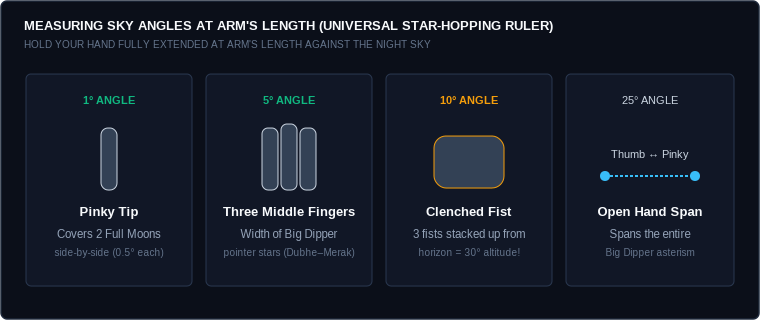
- The Brow-Grip Triangle: Hold the binoculars near the heavy front objective barrels (or wrap index fingers up against the Sides of your brow bones/eyeglasses) and tuck elbows firmly against your ribs.
- Reclining Lawn Chair / Zero-Gravity Lounger: Leaning back 45°–60° with armrests supporting your elbows turns overhead zenith sweeping through Cygnus and Cassiopeia into effortless luxury.
- Car Roof / Balcony Parapet Brace: Fold a thick towel on top of a parked car roof or stone terrace wall and plant both elbows squarely onto it.
- Upside-Down Broomstick Stabilization: Stand an ordinary household broom upside-down so the soft bristles cradle the binocular hinge while the wooden handle rests on the ground—eliminating 85% of vertical bobbing for $0!
- $12 1/4"-20 Tripod L-Adapter: Unscrew the tiny plastic decorative cap on the front nose of your binocular's central hinge to reveal hidden brass camera threads—bolt it onto any photo tripod or monopod so friends and kids can step right up to a pre-aimed view of Jupiter's moons!
Top 12 Must-See Binocular Targets Tonight
- Jupiter & Its 4 Galilean Moons: Brace your elbows and watch Io, Europa, Ganymede, and Callisto line up like tiny pearls changing positions every night.
- The Crescent & Quarter Moon: Earthshine, Mare Crisium, Tycho's 1,500-km rays, and terminator craters pop in crisp 3D.
- Thin Crescent Venus: Within 3–4 weeks of inferior conjunction, braced 10×50s resolve Venus's 55-arcsecond horns during twilight!
- Uranus & Neptune: Track the seventh and eighth planets of our Solar System against Taurus and Pisces starfields.
- Twilight Mercury: Pick elusive Mercury effortlessly out of bright cobalt sunset glow 30 minutes after sundown.
- The Pleiades (M45 · Taurus): Six naked-eye sisters explode into 60+ icy sapphire diamonds filling an entire binocular frame.
- The Orion Nebula (M42) & Sword: Glowing stellar nursery flanked by sparkling star clusters just below Orion's Belt.
- The Andromeda Galaxy (M31): At 2.5 million light-years away, the farthest object easy to spot—spanning 3° under dark skies!
- The Beehive Cluster (M44 · Cancer): Rich swarm of golden and white stars easily visible even from suburban Bortle 6–7 yards.
- The Perseus Double Cluster (NGC 869 & 884): Twin glittering treasure chests framed side-by-side in one 6° view.
- Lagoon & Trifid Nebulae (M8 & M20 · Sagittarius): Sweeping up the summer/monsoon-break Teapot spout reveals clouds of starbirth and dark dust lanes.
- Albireo & The Coathanger Asterism (Collinder 399): An uncanny upside-down celestial coathanger of ten bright 5th–7th magnitude stars in Vulpecula!
Frequently Asked Questions
Can you see Saturn's rings with 10x50 binoculars?
At 10x magnification, Saturn's ~40-arcsecond ring span subtends about 400 arcseconds (6.7 arcminutes)—just large enough on a rock-steady tripod to notice Saturn looks distinctly oval ('stretched with tiny ears') compared to round stars, though cleanly seeing the dark sky gap between the rings and globe requires ~30x–45x in a spotting scope or telescope.
Why do I see two separate circles instead of one merged image in my binoculars?
First, bend the central hinge closer or wider to match your exact interpupillary eye spacing. If two stars still refuse to merge vertically or diagonally even at proper eye width, one internal Porro prism was knocked out of collimation from a drop—avoid buying dropped secondhand binoculars without star-testing them first!
Are Image-Stabilized (IS) binoculars worth the high price for astronomy?
Canon and Fujinon active gyro-stabilized binoculars (such as 10x42 IS, 12x36 IS, or 15x50 IS) are legendary among astronomers—pressing the stabilization button instantly freezes stars motionless and adds ~1.5 magnitudes of reach without carrying a tripod, though a $12 tripod adapter on standard 10x50s achieves 95% of that steadiness on a tiny budget.
What does 'field of view: 114m / 1000m' or '341 ft at 1,000 yds' mean in degrees?
Divide feet-at-1,000-yards by 52.5 (or meters-at-1,000m by 17.5) to get your True Field of View in sky degrees! For example, 341 ÷ 52.5 = 6.5°—wide enough to hold thirteen Full Moons side-by-side.
Can I wear eyeglasses with binoculars?
Yes! Twist down or fold back the rubber eyecups completely so your spectacle lenses sit right near the ocular glass, and choose models advertising at least 15mm–18mm of eye relief.