Beyond the Planets: Top 15 Messier Nebulae, Galaxies & Star Clusters for Beginners
- Compiled in Paris by comet hunter Charles Messier between 1758 and 1782, the 110-object Messier Catalog ('M1' through 'M110') accidentally became the ultimate bucket list of the brightest deep-sky treasures visible from Earth!
- Honest Visual Rule: Human night-vision rod cells see in monochrome—so while star clusters sparkle with gold and sapphire colors, faint nebulae and distant galaxies appear as haunting, delicate silver-grey ghostly clouds rather than neon Hubble posters.
- Ten of our Top 15 beginner showpieces are visible right in 10×50 binoculars, and half punch cleanly through suburban Bortle 6–7 skyglow!
- Wait for nights with minimal Moon glare, give your eyes 20 minutes of dark adaptation, and start with a wide 25mm–32mm eyepiece.
How a Frustrated Comet Hunter Created Stargazing's Greatest List
Once you have marveled at Saturn's icy rings, Jupiter's moons, and lunar craters, your telescope holds a second, vastly deeper superpower: acting as a time machine collecting ancient photons that left stellar nurseries, dying stars, and external island universes thousands to tens of millions of years ago!
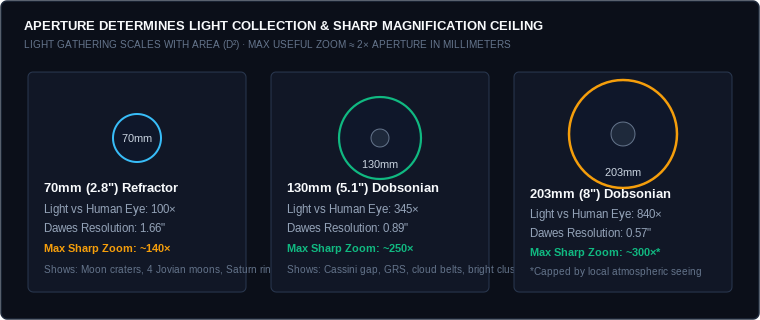
Ironically, the world's most famous deep-sky checklist began as a list of nuisances to ignore. In August 1758, French astronomer Charles Messier was sweeping Taurus with a small 4-inch reflector hunting for the predicted return of Halley's Comet when he stumbled across a stationary, misty patch of light—the supernova remnant we now call the Crab Nebula (Messier 1, or M1). Realizing other comet hunters would waste hours mistaking fixed nebulae and clusters for moving comets, Messier and his colleague Pierre Méchain cataloged 110 bright non-cometary deep-sky showpieces—every single one accessible today in an ordinary 70mm to 203mm backyard telescope!
Setting Honest Eyepiece Expectations: Monochrome Rods vs. Camera Sensors
Per our Zero-Hype Editorial Policy, let's set crystal-clear visual expectations before you hunt your first galaxy. Long-exposure astro-cameras accumulate photons for five hours onto RGB sensors, turning faint hydrogen gas vivid magenta. As explained in our Dark Adaptation Guide, the human eye observes faint nebulae live in real time using monochrome scotopic rod cells:
- Open & Globular Star Clusters: Look better visually through a real eyepiece than in photographs! No monitor on Earth can replicate the dynamic range of hundreds of pin-sharp diamond stars glittering with real subtle gold, blue-white, and garnet tints against velvet black space.
- Emission Nebulae & Galaxies: Appear visually as luminous, ethereal pearl-grey, silver-green, or smoky wisps—yet knowing with certainty that 2.5-million-year-old photons from the Andromeda Galaxy are physically striking your own living retina creates a goosebump thrill no wallpaper download ever matches!
Master Table: The 15 Brightest & Most Rewarding Messier Showpieces
| Object | Type & Constellation | Distance | Prime Months | City Friendly? | What to Look For (Binoculars / 80mm–203mm Scope) |
|---|---|---|---|---|---|
| M45 Pleiades | Open Cluster · Taurus | 444 ly | Oct – Mar | Yes (Bortle 8) | 60+ icy blue-white stars; best in binoculars or 25mm–32mm wide eyepiece |
| M42 Orion Nebula | Stellar Nursery · Orion | 1,344 ly | Nov – Mar | Yes (Bortle 8) | Sprawling bat-winged glowing gas cloud cradling the 4 pinpoint stars of the Trapezium! |
| M31 Andromeda | Spiral Galaxy · Andromeda | 2.54M ly | Sep – Jan | Core OK / Halo Dark | Bright oval core in suburbs; spans 3° with companion galaxies M32 & M110 under dark skies |
| M13 Great Globular | Globular · Hercules | 22,200 ly | Apr – Sep | Good (Bortle 6–7) | Fuzzy snowball in 70mm; explodes into 300,000 resolved stars at 130× in 6"–8" scopes! |
| M44 Beehive (Praesepe) | Open Cluster · Cancer | 577 ly | Jan – May | Yes (Bortle 7) | Dozens of bright 6th–7th mag golden & white triples; stunning in 10×50 binoculars |
| M8 Lagoon Nebula | Emission Nebula · Sagittarius | 4,100 ly | Jun – Sep | Suburbs (+UHC) | Embedded star cluster split by a dark dust lane right above the Sagittarius Teapot spout |
| M57 Ring Nebula | Planetary Nebula · Lyra | 2,300 ly | May – Oct | Yes (Bortle 7!) | Compact cosmic smoke-ring neatly framed halfway between Sulafat & Sheliak at 100×–150×! |
| M27 Dumbbell Nebula | Planetary Nebula · Vulpecula | 1,360 ly | Jun – Nov | Good (Bortle 6) | Large, bright apple-core / hourglass glow; pops dramatically with a narrowband UHC filter |
| M22 Sagittarius Cluster | Globular · Sagittarius | 10,600 ly | Jun – Sep | Yes (Bortle 7) | Even brighter and closer than M13! Resolves into rich stardust even in 100mm–130mm scopes |
| M11 Wild Duck Cluster | Rich Open Cluster · Scutum | 6,100 ly | Jun – Oct | Yes (Bortle 7) | Nearly 3,000 tightly packed stars arranged in a V-formation led by one bright gold apex star |
| M81 & M82 Pair | Galaxy Pair · Ursa Major | 11.8M ly | Jan – Jun | Bortle 1–6 | Two contrasting galaxies inside one low-power view: oval spiral M81 beside cigar-edge starburst M82! |
| M17 Omega / Swan | Emission Nebula · Sagittarius | 5,500 ly | Jun – Sep | Suburbs (+UHC) | Unmistakable graceful celestial swan gliding across a starry pond in 114mm+ scopes |
| M35 (Plus NGC 2158) | Open Cluster · Gemini | 2,970 ly | Nov – Apr | Yes (Bortle 7) | Curving chains of stars right at Castor's foot, with distant cluster NGC 2158 glowing beside it in 6"+ |
| M104 Sombrero Galaxy | Edge-On Spiral · Virgo | 31M ly | Mar – Jun | Bortle 1–5 | Crisp spindle halo bisected cleanly by an ink-black equatorial dust lane at 120× in 6"–8" scopes |
| M51 Whirlpool Galaxy | Interacting Galaxies · Canes Venatici | 31M ly | Mar – Jul | Bortle 1–4 | Twin galaxy cores in 4" scopes; true spiral arm structure emerges in 8"+ under dark rural skies! |
Four Categories of Deep-Sky Wonders Explained
- Open Star Clusters (e.g., M45, M44, M35, M11): Loose sibling groups of dozens to thousands of young stars recently hatched from the same molecular cloud inside our Milky Way. Use low to medium power (`25×–80×`).
- Globular Star Clusters (e.g., M13, M22, M5, M3): Ancient, tightly packed gravitational spheres of 100,000 to 1,000,000 stars orbiting our galaxy's halo (~12 billion years old!). Bump power up (`110×–180×`) to resolve individual stars across the core.
- Diffuse & Planetary Nebulae (e.g., M42, M8, M57, M27): Either vast nurseries forging brand-new stars and protoplanetary disks (`M42`), or glowing shells of ionized gas cast off by sun-like stars at the end of their lives (`M57`—named "planetary" only because small 18th-century scopes made their round greenish-blue disks resemble Uranus!).
- External Galaxies (e.g., M31, M81/M82, M51, M104): Entire island universes containing hundreds of billions of suns floating millions of light-years outside our Milky Way!
Planning Your First Mini "Messier Marathon" Session
Every March and early April near New Moon, the Sun sits along the Pisces/Aries border—a rare sparse gap in Messier's catalog—allowing dedicated observers to stay up from dusk to dawn and bag 105 to 110 Messier objects in a single night! As a beginner, skip the exhausting all-night sprint and pick just five seasonal gems per clear moonless evening. Note that our Live Planets Tonight Sky Table already computes real-time rise times and compass directions for flagship deep-sky gems like M42, M45, M31, M13, and M8 alongside tonight's planets!
Frequently Asked Questions
Why can't I find M31 (Andromeda) or M51 when the Full Moon is up?
Galaxies have low surface brightness spread thinly across sky area. Bright moonlight turns the entire sky background brighter than a galaxy's delicate outer spiral arms, leaving only the tiny central core visible. Always hunt galaxies during the two-week dark window between Last Quarter and First Quarter Moon!
Which single Messier object is the absolute #1 crowd-pleaser for guests?
In winter/early spring, the Orion Nebula (M42) wins hands-down—even from bright city balconies, everyone immediately gasps at the glowing nebulosity wrapping around the four tiny jewel stars of the Trapezium! In summer, the Hercules Globular (M13) in an 8-inch scope and the Ring Nebula (M57) tie for top honors.
Why didn't Messier include the famous Double Cluster in Perseus or Omega Centauri?
Two reasons: first, Messier observed from Paris (`48.8°N`), so deep southern wonders like Omega Centauri and 47 Tucanae never rose above his southern horizon! Second, well-known naked-eye northern showpieces like the Double Cluster wouldn't fool anyone into thinking they were new comets (though he added M42 and M45 in 1769 simply to round his first published list neatly up to 45 entries!).
What eyepiece magnification should I use on the Ring Nebula (M57)?
Beginners often miss M57 at 35x because its 1.4-arcminute smoke ring looks almost as small as a slightly bloated 9th-magnitude star! Once you center the midpoint between Lyra's two bottom stars, swap immediately to 100x–160x and the ghostly donut hole inside the ring pops right open.
Can a 70mm refractor really show another galaxy 12 million light-years away?
Yes! Under a dark Bortle 3–4 countryside sky with dark-adapted eyes, a humble 70mm refractor at 35x–50x clearly shows the twin ghostly ovals of M81 and M82 floating 12 million light-years away in Ursa Major!