The Bortle Dark-Sky Scale (Classes 1–9): What You Can See From Any Sky
- Created by astronomer John E. Bortle in 2001, the Bortle Scale ranks night-sky artificial skyglow from Class 1 (pristine desert/mountain darkness) to Class 9 (downtown inner-city glare).
- City skyglow (Bortle 7–9) has virtually ZERO negative impact on the Moon, Venus, Jupiter, Saturn, Mars, Uranus, double stars, and bright open clusters!
- Galaxies and reflection nebulae shine across broad continuous spectra that no magic 'light pollution filter' can fully rescue from LED streetlights—even a 45-minute drive from Bortle 8 to Bortle 4 boosts galaxy contrast more than tripling mirror cost.
- Measure your own backyard Bortle class tonight in 2 minutes by counting Little Dipper or Orion stars overhead.
Why Artificial Skyglow Washes Out Nebulae (Surface Brightness Physics)
Why can an 8-inch telescope sitting on a crowded apartment balcony in downtown Mumbai or Manhattan split sub-arcsecond double stars and etch razor-sharp festoons across Jupiter, yet struggle to show the spiral arms of the Whirlpool Galaxy (M51) that pop effortlessly in a tiny 80mm scope from a rural campsite? The answer is Contrast Ratio against Sky Background.
Unshielded streetlights, billboards, and stadium floods scatter upward off dust, water vapor, and air molecules (Rayleigh and Mie scattering), wrapping cities inside a luminous grey-orange dome called skyglow. In a pristine natural night sky, the background glows faintly at roughly `22.0 magnitudes per square arcsecond` (natural airglow and starlight). In a dense inner city, skyglow surges past `17.5 magnitudes per square arcsecond`—more than 60 times brighter! Any faint galaxy halo dimmer than that bright urban ceiling loses contrast completely, regardless of telescope size.
Complete Bortle Class 1 to Class 9 Visual Reference Table
In February 2001, veteran observer John E. Bortle published a practical nine-step visual scale so amateurs could rate real sky transparency and darkness beyond crude star counts:
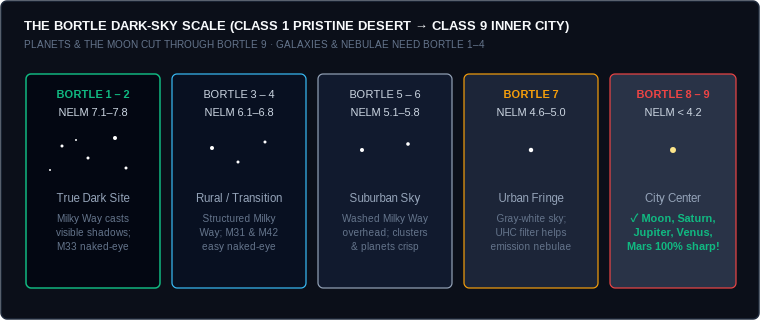
| Bortle Class | Environment | Naked-Eye Limit (NELM) | SQM Reading (mag/arcsec²) | Visual Sky Benchmarks & Telescope Capabilities |
|---|---|---|---|---|
| Class 1 | Pristine Dark Site (Atacama, Hanle/Ladakh, Big Bend) | 7.6 – 8.0 | 21.9 – 22.0 | Zodiacal light & Gegenschein prominent; Scorpio/Sagittarius Milky Way casts diffuse ground shadows; M33 easy naked-eye |
| Class 2 | True Dark Site (National Parks, Outback) | 7.1 – 7.5 | 21.7 – 21.9 | Summer Milky Way richly veined with dark dust lanes; M33 seen directly; dozens of Messier globulars visible naked-eye |
| Class 3 | Rural Sky | 6.6 – 7.0 | 21.4 – 21.7 | Slight light domes low on distant horizon; Milky Way complex overhead; M15, M4, M5, M22 visible naked-eye |
| Class 4 | Rural / Suburban Transition | 6.1 – 6.5 | 20.5 – 21.3 | Milky Way impressive above 30° though washed near horizon; M31 Andromeda & Uranus (+5.7) clear naked-eye; galaxies rich in 6"+ scopes |
| Class 5 | Suburban Sky | 5.6 – 6.0 | 19.5 – 20.4 | Milky Way weak/patchy near zenith and invisible low down; clouds look brighter than the dark sky behind them; clusters & bright nebulae strong |
| Class 6 | Bright Suburban Sky | 5.1 – 5.5 | 18.9 – 19.5 | Milky Way barely hinted straight overhead on crisp autumn nights; M31 core visible in binoculars; open/globular clusters & planetary nebulae crisp |
| Class 7 | Suburban / Urban Transition | 4.6 – 5.0 | 18.4 – 18.9 | Entire sky has vague greyish-white hue; main constellation outlines intact; UHC filter unlocks Orion (M42), Lagoon (M8) & Ring (M57) |
| Class 8 | City Sky | 4.1 – 4.5 | 17.8 – 18.4 | Sky glows pale orange/white; you can read newspaper headlines without a flashlight! Planets, Moon, double stars & Pleiades/Beehive excel |
| Class 9 | Inner-City Downtown | < 4.0 | < 17.8 | Only brightest constellation stars, Moon, Venus, Jupiter, Saturn & Mars shine naked-eye—yet telescopic planetary detail remains 100% unaffected! |
How to Measure Your Backyard Bortle Class Tonight (No Meter Needed)
Wait until astronomical twilight ends (`~90 minutes` after sunset) on a night when the Moon is below the horizon, give your eyes 15–20 minutes away from screens, and inspect two familiar sky benchmarks high overhead:
- Northern Hemisphere (Ursa Minor — The Little Dipper): Its seven main stars conveniently span magnitudes +2.0 (Polaris and Kochab), +3.0 (Pherkad), +4.2–+4.3 (Yildun and Epsilon), +4.95 (Zeta), and +5.0 (Eta)! If you only see Polaris and Kochab, you are in Bortle 8–9; seeing all four bowl corners places you in Bortle 5–6; easily seeing all seven plus faint interior stars puts you in Bortle 1–4.
- Global Winter/Summer Check (Orion & The Cloud Test): In a natural dark sky (Bortle 1–3), passing clouds look like pitch-black holes silhouetting out the stars! In Bortle 5 through 9, passing clouds reflect ground streetlights and glow brighter than the surrounding sky.
Thriving in Bortle 7–9 Cities: What Still Looks Razor-Sharp
More than 80% of humanity lives under Bortle 6–9 domes—so never let light pollution keep your telescope indoors! Build your urban observing playbook around high-surface-brightness targets that punch effortlessly through skyglow:
- All Solar System Worlds: Saturn, Jupiter, Mars, Venus, Mercury, The Moon, and even Uranus & Neptune in a finder/telescope!
- Colorful Double & Multiple Stars: Sapphire-and-gold Albireo in Cygnus, the "Double-Double" Epsilon Lyrae, Almach in Andromeda, and Castor in Gemini look jewel-like from downtown rooftops.
- Compact Open & Globular Star Clusters: Bump magnification up to `100×–150×` (which darkens background skyglow dramatically while keeping pinpoint stars bright!) on the Double Cluster, M13 Hercules, M37, M11 Wild Duck Cluster, and compact planetary nebulae like the Ring Nebula (M57).
Truth About Light Pollution Filters in the Modern White-LED Era
Twenty years ago, cities used yellow high-pressure and low-pressure sodium streetlamps emitting narrow yellow lines around `589 nm`, allowing broadband "CLS / SkyGlow" filters to notch out yellow glare cleanly. Today, municipal white LED lamps blast continuous broadband blue-green-red light across the entire visual spectrum (`440–680 nm`).
What Works Today vs. What Doesn't:
- Skip Broadband "Light Pollution" Filters for Visual Galaxies/Clusters: Because stars and galaxies also emit broadband continuum light, broadband filters dim galaxies almost as much as LED skyglow. Save that money for a tank of petrol to a Bortle 3–4 park!
- Narrowband UHC & O-III Nebula Filters Still Work Wonders: Glowing emission and planetary nebulae (Orion M42, Lagoon M8, Swan M17, Dumbbell M27, Veil Nebula) radiate 90% of their visual light at two surgical atomic wavelengths: Doubly Ionized Oxygen (`O-III` at 496/501 nm) and Hydrogen-Beta (`H-β` at 486 nm). A quality narrowband UHC (Ultra High Contrast) filter blocks 92% of broadband LED glare while passing 95% of nebula emission—making M42 leap out of suburban skies!
Frequently Asked Questions
Does a bigger telescope beat city light pollution on galaxies?
Partially, with a catch: an 8-inch or 10-inch Dobsonian in a city gathers far more light than a 70mm scope, letting you see bright galaxy cores (like M81, M82, M31, and the Sombrero M104), EXCEPT it simultaneously gathers that same extra amount of city skyglow! A modest 80mm–130mm scope under a rural Bortle 3 sky beats a 12-inch telescope in downtown Bortle 9 on faint spiral arms every single time.
Does a Full Moon effectively raise my Bortle Class even in the countryside?
Yes! Even at a remote Bortle Class 1 desert observatory, a dazzling Full Moon scatters blue-white Rayleigh light across the atmosphere, temporarily turning the sky into the visual equivalent of a suburban Bortle Class 5 or Class 6 sky for faint nebulae. Plan dark-sky road trips around the 10-day New Moon window!
Why is light pollution worse on humid or hazy nights?
Dry, crisp winter air has minimal suspended water droplets and aerosols, so upward-aimed city lights escape mostly out into space. High humidity, smog, or thin cirrus haze scatters streetlamp light right back down into your telescope, multiplying skyglow brightness twofold to threefold.
What time of night is city skyglow darkest?
Between 1:00 AM and 4:00 AM local time! Commercial shop signage, sports stadiums, office towers, and highway traffic drop significantly after midnight—often improving urban sky darkness by 0.3 to 0.5 magnitudes compared to 8:30 PM.
Do I need a UHC filter to see planets from a city?
Never! Nebula UHC/O-III filters turn planets weirdly green-teal and dim them unnecessarily. Planets already outshine urban skyglow thousands-fold with zero filtration needed.