Mercury Tonight: Live Twilight Position, Elongation Windows & Observing Guide
Mercury is the fastest, innermost planet of our Solar System—racing around the Sun every 87.97 Earth days and playing hide-and-seek low in bright evening dusk or pre-dawn twilight.
- Mercury is strictly a twilight target: it never strays more than 18° to 28° from the Sun, meaning it sets roughly 60–90 minutes after sundown (or rises 60–90 minutes before sunrise) even during its best weeks.
- Six times each year—three evening apparitions and three morning apparitions—Mercury swings out to Greatest Elongation, opening a crisp 10-to-16-day naked-eye window.
- Look for a steady, slightly pinkish-ochre or warm salmon star sitting 1 fist (10°) above an unobstructed western or eastern horizon; 7×50 or 10×50 binoculars make spotting it effortless.
- CRITICAL SAFETY: Never lift binoculars or aim a telescope toward Mercury until the Sun is 100% below your local horizon.
How to Spot Elusive Mercury in Twilight Tonight
Astronomy lore claims that Nicolaus Copernicus—the very mathematician who placed the Sun at the center of the Solar System—went through his entire life in misty northern Poland without ever glimpsing Mercury with his own eyes. In truth, Mercury is not faint at all! During favorable apparitions, Mercury shines between magnitude −1.2 and −0.2, outshining nearly every star in the sky except Sirius and Canopus. The challenge is purely geometric: Mercury orbits just 57.9 million kilometers (0.39 AU) from the Sun, keeping it permanently tethered near the horizon's twilight glow, trees, and apartment rooflines.
To catch Mercury tonight without guesswork, check the live telemetry readout above first. If Mercury is currently in an active evening or morning apparition, find a viewing spot—a beach, hilltop, open park, or high terrace—with a completely clear, flat view down to within 3°–5° of the western (dusk) or eastern (dawn) horizon. About 30 to 40 minutes after local sunset (or before sunrise), scan the exact compass bearing shown above at roughly one closed fist's height (`8°–15°`) for a steady, warm peach-gold or pinkish-yellow point of light.
Greatest Elongation: Why Only Six 2-Week Windows Matter Each Year
Because Mercury whips around the Sun in just 88 days while Earth moves forward along its own orbit, Mercury laps Earth once every 115.88 days (its synodic period). That rapid rhythm produces roughly three Greatest Eastern Elongations (evening sky in the West) and three Greatest Western Elongations (morning sky in the East) every calendar year.
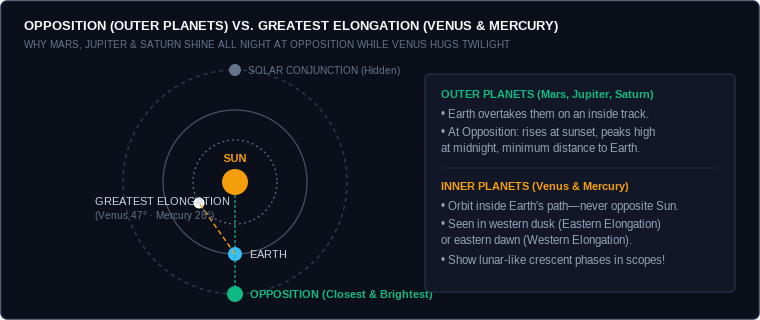
Why do some elongations stretch to nearly 28° while others barely reach 18°? Unlike Venus's nearly circular path, Mercury follows a highly elliptical orbit (`eccentricity = 0.2056`):
- Perihelic Elongations (~18° from the Sun): Mercury sits only 46 million km from the Sun, hugging solar glare more closely, though its sunlit surface is fiercely bright.
- Aphelic Elongations (~27.8° from the Sun): Mercury swings out to 70 million km from the Sun, creating wide angular separation—especially rewarding for observers in tropical and Southern Hemisphere latitudes!
The Ecliptic Angle Secret: Why Some Seasons Beat Others
Angular separation from the Sun is only half the battle; what truly determines how high Mercury climbs above dusty horizon haze is the steepness of the ecliptic relative to your horizon:
- Mid-Northern Latitudes (US, Europe, North India · 28°N–52°N): In March, April, and May evenings, the ecliptic rises almost vertically up from the western sunset point, lifting an 18°–20° Mercury elongation maximally straight upward into dark blue sky! Conversely, in September and October mornings, the pre-dawn eastern ecliptic stands nearly vertical, creating the year's finest dawn views.
- Tropical & Equatorial Observers (South India, SE Asia, East Africa · 0°–20°): Because the zodiacal band always intersects tropical horizons at a steep, favorable 65°–90° angle, low-latitude stargazers enjoy remarkably consistent access to all six annual Mercury elongations—particularly wide 27° aphelic windows!
- Southern Hemisphere (Australia, South Africa, South America): The seasonal rule flips cleanly: August–October evenings and March–May mornings deliver towering twilight altitudes.
Binocular Sweeping & Telescopic Phases of Mercury
A pair of 7×50 or 10×50 binoculars is the ultimate secret weapon for Mercury. Bright twilight sky glow reduces naked-eye contrast, whereas binocular lenses gather 50 to 100 times more light than your pupil, making Mercury pop starkly out of an orange-violet sunset sky 20 minutes before bare eyes spot it. Once locked in binoculars, center your telescope at 80× to 140× magnification to track Mercury's rapid lunar-style phases:
| Apparition Stage (Evening Example) | Illuminated Phase | Angular Size | Typical Magnitude | Telescopic & Visual Notes |
|---|---|---|---|---|
| 12–15 Days Before Greatest Elongation | 80% – 90% Gibbous | 5.2" – 5.8" | −1.3 to −0.8 | Very bright and easiest to spot early in dusk; compact gibbous oval at 120× |
| Greatest Eastern Elongation (Peak Height) | ~48% – 52% (Dichotomy) | 6.8" – 8.0" | −0.4 to +0.2 | Highest altitude above the western horizon; miniature D-shaped Half-Moon disk |
| 6–9 Days After Greatest Elongation | 20% – 32% Crescent | 8.8" – 10.4" | +0.6 to +1.4 | Fades rapidly every evening as night side turns toward Earth; delicate crescent in 100mm+ scopes |
Dealing With Horizon Shimmer: Because you are always viewing Mercury through 3 to 6 air masses (`8°–18°` elevation), atmospheric refraction splits Mercury's tiny disk into a miniature vertical rainbow—red-orange on the bottom rim and blue-cyan on the top rim. Observe as early in civil/nautical twilight as you can locate the planet, while it still sits above the worst 6° ground boundary layer, and thread a #21 Orange or #23A Light Red filter onto your eyepiece in 130mm+ reflectors to steady single-wavelength contrast.
Mandatory Solar Safety Protocol Near the Horizon
Because Mercury always lurks within two or three fist-widths of the Sun, treat every twilight session with disciplined optical safety. Never sweep binoculars, a finder scope, or an unfiltered telescope toward the western horizon until the upper limb of the Sun has completely sunk below the physical horizon—and during morning elongations, cap your optics immediately at least five minutes before local sunrise. Accidental concentrated sunlight causes instant, permanent retinal injury.
Frequently Asked Questions
Why is Mercury harder to see than Venus even when Mercury is bright?
Venus swings up to 47° away from the Sun, allowing it to shine high in pitch-dark skies for 3 hours after sunset. Mercury never exceeds 18°–28° from the Sun, confining it to low altitudes during twilight where horizon trees, buildings, and urban haze often block the view.
What color does Mercury look like to the naked eye?
High in clear twilight air, Mercury has a subtle warm leaden-white or pale ochre tint; when sitting 5° to 10° above the horizon, atmospheric Rayleigh scattering filters out blue wavelengths so Mercury gleams warm salmon-pink or orange-gold.
Why does Mercury fade so fast right after Greatest Eastern Elongation?
As Mercury rounds its orbit between Earth and the Sun after an evening elongation, we rapidly see more of its dark, cratered night hemisphere—and unlike cloudy Venus, Mercury's bare, porous silicate regolith (similar to our Moon) back-scatters sunlight poorly at narrow crescent angles.
Can a backyard telescope show craters on Mercury?
No. Even at closest approach, Mercury spans only ~10 to 12 arcseconds while sitting low in turbulent air. Amateur 100mm to 203mm telescopes cleanly resolve Mercury's gibbous, half, and crescent phases, while skilled high-speed planetary imagers using IR-pass filters occasionally capture broad dark/bright albedo provinces.
How often does Mercury transit directly across the face of the Sun?
Mercury transits the solar disk roughly 13 times per century (always in May or November, where Mercury's 7°-tilted orbit crosses Earth's ecliptic plane). Following the November 2019 transit, the next solar transit of Mercury occurs on November 13, 2032—requiring a certified ISO 12312-2 solar filter to view.