Uranus Tonight: Binocular Star-Hopping & Resolving the Ice Giant's Cyan Globe
Orbiting nearly 2.9 billion kilometers from the Sun, Uranus hovers right on the razor edge of human naked-eye vision (magnitude +5.6 to +5.9)—making it an unforgettable milestone in binoculars or any backyard telescope.
- Uranus is technically the most distant planet visible to the unaided human eye—appearing as a faint magnitude +5.7 pinpoint under rural Bortle 1–3 skies, and an effortless target in 7×50 or 10×50 binoculars even from suburbs!
- Across 2026 and 2027, Uranus glides slowly through western Taurus just south of the Pleiades star cluster (M45), providing an unmistakable celestial landmark for star-hopping.
- At 120× to 180× magnification in any 80mm+ telescope, Uranus stops looking like a star and resolves into a distinct, calm, robin's-egg cyan-green sphere 3.7 arcseconds wide.
- Large amateur apertures (203mm / 8-inch and up) under dark skies can glimpse Uranus's two largest moons, Titania and Oberon.
Can You Really See Uranus With the Naked Eye?
Although Uranus measures 50,724 kilometers across—four times wider than Earth—it orbits nineteen times farther from the Sun (`19.2 AU`), where sunlight is 370 times fainter than in your backyard. Even so, its bright icy cloud tops bounce back enough light for Uranus to shine between magnitude +5.6 at opposition and +5.9 near conjunction.
Since a healthy, dark-adapted human eye under rural Bortle Class 1 to Class 3 skies can detect stars down to magnitude +6.2 to +6.8, yes—you can genuinely spot Uranus without any optical aid from a dark countryside site once you know its exact star-field triangle! From suburban or urban balconies (Bortle 5–9), skyglow hides 5.7-magnitude points from bare eyes, yet lifting any 7×50 or 10×50 binoculars immediately reveals Uranus as a crisp, steady star-like jewel.
Step-by-Step Binocular Star-Hopping Strategy Tonight
Because Uranus takes 84 Earth years to complete one lap around the Sun, it creeps eastward by only ~4.3° per year. Throughout the 2026–2027 observing seasons, Uranus resides in a wonderfully convenient neighborhood: Taurus the Bull, within roughly 4° to 6° south/southeast of the famous Pleiades star cluster (Messier 45, the Seven Sisters).
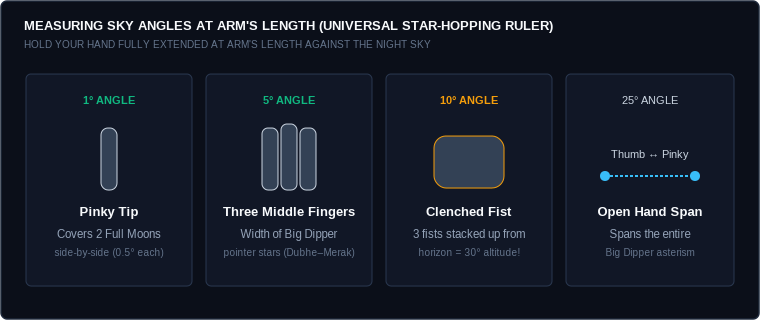
- Lock Your Coordinates Above: Check Uranus's live altitude, compass direction, and peak transit time in the telemetry panel at the top of this page.
- Anchor on the Pleiades (M45): Locate the misty dipper-shaped cluster of the Pleiades high in the evening sky (or use our 180° Live Sky Radar). Standard 10×50 binoculars have a true field of view of roughly 6.0° to 6.5°—wide enough in 2026–2027 to frame the Pleiades near one edge and Uranus near the opposite edge!
- Verify by Color & Motion: Among 6th-magnitude background stars (many of which appear warm white or orange), Uranus often betrays a subtle cool greenish-ivory cast in binoculars. Sketch the 3 or 4 closest stars around your suspect tonight, then check again 48 hours later: Uranus will have drifted ~3 to 5 arcminutes against the fixed starry backdrop!
Resolving Uranus's Pale Cyan-Green Methane Disk
Switching from binoculars to a telescope produces one of amateur astronomy's quietest "aha!" thrills. At low finder power (`25×–45×`), Uranus still masquerades as a slightly "fat" star. Swap in a planetary eyepiece to reach 120× to 180× magnification, refocus carefully on a neighboring star until its diffraction airy disk is razor-tight, and look back at Uranus:
- A True Planetary Globe: Stars remain infinitesimal pinpoints regardless of zoom, whereas Uranus expands into a neat, unmistakable circular bead 3.6 to 3.8 arcseconds across with softly darkened limbs!
- Why Uranus Is Aquamarine: Uranus's upper hydrogen-helium atmosphere contains roughly 2.3% methane gas (`CH₄`). Methane molecules strongly absorb red and orange solar wavelengths (`600–700 nm`) while scattering blue and green photons back into space—producing a delicate, luminous robin's-egg cyan or pale seafoam-green hue unlike any star in the heavens.
Aperture Guide & Hunting Uranus's Moons (Titania & Oberon)
Long ago, a colossal protoplanetary collision knocked Uranus onto its side at an axial tilt of 97.77°—meaning Uranus essentially rolls around the Sun on its side, and its moons orbit perpendicular to the ecliptic like a bullseye target during solstice decades!
| Optical Instrument | Recommended Zoom | What You Will See |
|---|---|---|
| 7×50 / 10×50 Binoculars | 7× – 10× | Easy magnitude +5.7 star-like point; tracks orbital motion over 2–3 nights |
| 70mm – 90mm Refractor | 100× – 140× | Non-stellar tiny pale greenish-blue dot; clearly broader and calmer than adjacent stars |
| 114mm – 150mm Reflector / Mak | 140× – 200× | Clean, evenly illuminated 3.7" cyan-green globe with distinct limb darkening |
| 203mm – 305mm (8"–12") Dobsonian | 220× – 300× | Vivid aquamarine disk + outer moons Titania (mag +13.9) and Oberon (mag +14.1) up to 30"–42" away under dark skies |
How William Herschel Spotted Uranus From His Back Garden
Ancient astronomers cataloged Uranus at least twenty times on star charts (John Flamsteed even labeled it "star 34 Tauri" in 1690!) without realizing it was moving. On the night of March 13, 1781, musician-turned-astronomer William Herschel was systematically sweeping Taurus from his garden in Bath, England, using a homemade 6.2-inch (157mm) f/13 reflector at 227× magnification. Immediately noticing one object looked visibly wider than surrounding stars—and grew proportionally larger when he inserted 460× and 932× eyepieces while true stars did not—Herschel made the first telescopic planet discovery in human history, doubling the known width of the Solar System overnight.
Frequently Asked Questions
Why didn't ancient astronomers discover Uranus if it's visible to the naked eye?
At magnitude +5.7, Uranus sits among roughly 3,000 stars of similar faintness, and its 84-year orbit makes it move 7 times slower across the sky than Saturn. Without telescopic magnification to reveal its 3.7-arcsecond disk, early skywatchers naturally assumed it was just another dim fixed star.
What magnification do I need to tell Uranus isn't a star?
At 50x Uranus already looks suspiciously 'calm' and slightly thicker than pinpoint stars, and by 110x to 160x in a well-focused 80mm+ telescope its round 3.7-arcsecond pale cyan globe is unmistakable.
Can I see Uranus's rings in a backyard telescope?
No. Unlike Saturn's brilliant water-ice rings, Uranus's 13 narrow rings are composed of radiation-darkened, coal-black boulders with an albedo below 2%. They were only discovered in 1977 when they briefly blinked out a background star during an occultation.
Can I spot Uranus from a light-polluted city?
Yes, easily with binoculars or a finder scope! Magnitude +5.7 cuts right through urban skyglow in 10x50 binoculars or a 6x30 optical finder—just use nearby brighter Taurus stars from our Sky Radar to star-hop accurately.
When is Uranus at opposition?
Uranus reaches opposition once every 369.7 days (shifting roughly 4 to 5 days later each calendar year—occurring in mid-to-late November during 2026 and 2027), shining all night from sunset to dawn at peak +5.6 brightness.