Neptune Tonight: Tracking the Outermost Ice Giant & Its Moon Triton
Orbiting 4.5 billion kilometers (30 AU) from the Sun, Neptune is the only major planet completely invisible to the naked eye—rewarding patient binocular and telescope observers with a deep ocean-blue photon stream that left Neptune over four hours ago.
- At magnitude +7.8, Neptune is roughly five times fainter than the naked-eye limit even under pristine desert skies—meaning optical aid (at least 10×50 binoculars or a telescope) is mandatory.
- In 2026–2027, Neptune travels along the Pisces–Cetus border in the same broad sky sector as Saturn, making it easy to jump from bright Saturn to Neptune's starfield.
- While small scopes show Neptune's distinct sapphire-blue color at 80×, resolving its tiny 2.3-arcsecond non-stellar globe requires 150× to 240× magnification in a well-cooled 114mm+ telescope.
- Owners of 203mm–305mm (8"–12") telescopes can hunt down Neptune's giant captured Kuiper-belt moon, Triton (magnitude +13.5).
Observing Across 4.5 Billion Kilometers of Space
Finding Neptune in your own backyard eyepiece is a rite of passage that completes the classic eight-planet Solar System checklist. Orbiting thirty times farther from the Sun than Earth (`30.07 AU`), Neptune receives just 1/900th of the solar irradiance that warms our planet. Sunlight takes roughly 4 hours and 10 minutes to reach Neptune's supersonic methane cloud decks, reflect off icy aerosols, and travel another 4 hours and 10 minutes back into your telescope mirror!
Because of that extraordinary 4.5-billion-kilometer round trip, Neptune never brightens past magnitude +7.7 at opposition (and hovers near +7.9 to +8.0 far from opposition). No human eye has ever seen Neptune without glass or mirrors—yet even an entry-level pair of tripod-braced 10×50 binoculars or a 70mm beginner refractor collects more than enough photons to pull Neptune cleanly out of the dark.
How to Locate Magnitude +7.8 Neptune Tonight
Unlike Jupiter or Saturn, where you simply point your finder crosshairs at a blazing beacon, locating Neptune among thousands of 7th- and 8th-magnitude stars requires methodical low-power star-hopping:
- Check Live Azimuth & Transit Time Above: Wait until Neptune climbs above at least 30° altitude during astronomical darkness (with minimal moonlight glare if using binoculars).
- Use the Pisces Circlet & Saturn Bridge (2026–2027): Because Neptune takes nearly 165 years to orbit the Sun, it moves barely 2.2° per year—currently gliding slowly beneath the "Circlet of Pisces" near the Cetus border, right in the same evening sky sector as Saturn!
- Start With a Wide 25mm–32mm Eyepiece: Never hunt for Neptune at high zoom. Insert your lowest-power eyepiece (`30×–50×`, giving a generous `1.0°–1.5°` field), hop from the nearest 4th- or 5th-magnitude naked-eye anchor star using geometric star triangles, and look for the one magnitude +7.8 "star" with an unmistakable cool cobalt/slate-blue tint.
Separating a 2.3-Arcsecond Azure Disk From Field Stars
At 2.2 to 2.4 arcseconds in apparent diameter, Neptune's disk is sixteen times narrower than Jupiter's! Below 100× magnification, Neptune looks almost indistinguishable in shape from surrounding pinpoint stars aside from its rich blue color and rock-steady lack of twinkling.
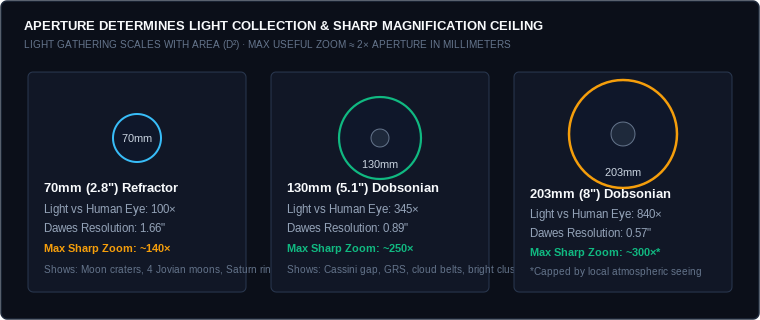
Once your suspect is dead-center in the eyepiece, step up systematically to 150×–240× magnification (read our Eyepiece Guide for exit-pupil tips):
- In 70mm – 90mm Scopes: Dawes' resolution limit is `1.3"–1.6"`, so at 130×–150× Neptune looks like a tiny, soft-edged blue-grey pearl—distinctly less spiky than an 8th-magnitude star right next to it.
- In 130mm – 203mm+ Scopes: With sub-arcsecond optical resolution (`0.57"–0.89"`), 180×–250× snaps Neptune into a miniature, unmistakably round deep ocean-blue marble floating against velvety black space! Atmospheric methane plus an unknown chromophore haze gives Neptune a noticeably deeper, richer azure blue than Uranus's pale cyan-green.
Hunting Triton: Neptune's Captured Kuiper-Belt Moon
If you observe with an 8-inch (203mm), 10-inch (254mm), or larger Dobsonian or SCT under dark Bortle 1–4 skies, Neptune holds an extraordinary bonus challenge: Triton. At 2,707 km wide, Triton is larger than Pluto and orbits Neptune backwards (retrograde) every 5.877 days—conclusive proof that Triton was once a free-roaming Kuiper Belt dwarf planet gravitationally captured by Neptune!
- Visual Magnitude & Separation: Triton shines around magnitude +13.4 to +13.6 and swings out to a maximum separation of ~16 to 17 arcseconds north/south or east/west of Neptune's globe.
- How to Catch It: Wait for a moonless night when Neptune passes its meridian transit (`>40°` high), use 220× to 300× magnification (which darkens the sky background and pulls Triton cleanly away from Neptune's glare), and apply averted vision—looking slightly beside Neptune so Triton's faint needle of light pops in and out at the 5.9-day orbital position!
Found by Mathematics: The 1846 Discovery Story
While Uranus was stumbled upon by accident, Neptune was discovered at the tip of a fountain pen. By the 1840s, astronomers noticed Uranus was drifting slightly ahead of, and then lagging behind, its Newtonian predicted path. French mathematician Urbain Le Verrier and English mathematician John Couch Adams independently calculated the mass and sky coordinates of an unseen perturbing world beyond Uranus. On the night of September 23, 1846, Johann Gottfried Galle at the Berlin Observatory pointed a 9-inch Fraunhofer refractor at Le Verrier's predicted coordinates—and spotted Neptune within less than 1° inside the very first hour of searching! (Remarkably, archival detective work later revealed Galileo had actually plotted Neptune right beside Jupiter in December 1612—even noting its slight motion—234 years earlier!)
Frequently Asked Questions
Can Neptune ever be seen with the naked eye during a 'planet alignment'?
Never. Even at its absolute closest opposition, Neptune shines at magnitude +7.7, which is roughly five times dimmer than the faintest stars visible to sharp human eyes under pitch-black mountain skies. Any social media graphic claiming '6 or 7 naked-eye planets tonight' including Neptune is inaccurate—bring binoculars or a telescope!
Can 10x50 binoculars show Neptune?
Yes! Under suburban or rural skies (Bortle 1–6) without bright Full Moon glare, tripod-mounted 10x50 binoculars reach magnitude +8.5 to +9.2, showing mag +7.8 Neptune as a steady star-like point. At 10x you won't see its round disk, so confirm it by star-chart pattern or motion over 3–4 nights.
Why is Neptune deeper blue than Uranus?
Both ice giants owe their blue-green colors to red-absorbing methane gas, but Hubble and Gemini North spectroscopy revealed that Uranus has a thicker, stagnant layer of whitish methane-ice aerosol haze that pales its tint to cyan, whereas Neptune's active vertical mixing keeps that upper haze thinner, yielding a deeper azure tone.
How fast does Neptune move against background stars?
Near opposition, Earth's faster orbital motion makes Neptune drift westward (retrograde) by roughly 1.5 to 2.5 arcminutes per day—a shift you can easily detect in a high-power eyepiece over two consecutive nights.
Has Neptune completed a full orbit since its discovery?
Just one! Discovered on September 23, 1846, with a 164.8-year orbital period, Neptune finally completed its very first full post-discovery lap around the Sun in July 2011, and won't finish its second until 2176.