Telescope Eyepieces Explained: How to Build a Razor-Sharp 3-Lens Kit
- Your telescope tube collects light at a single prime focal plane; the eyepiece is the precision multi-lens magnifier that determines your magnification, field width, and viewing comfort.
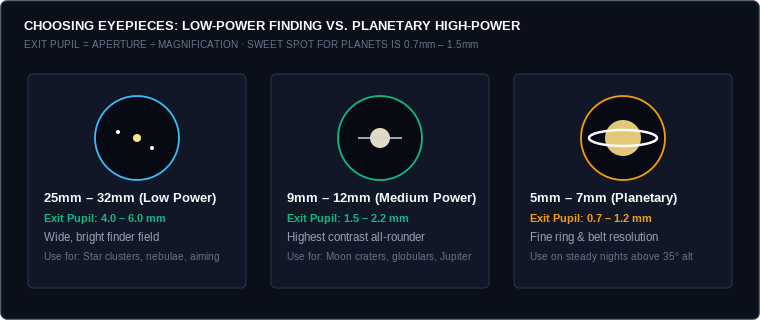
- Larger millimeter numbers (25mm–32mm) deliver wide, bright low-power finder views; smaller millimeter numbers (5mm–9mm) deliver high-power lunar and planetary close-ups.
- Avoid short focal-length (4mm–6mm) traditional Plössls because their tiny 3–4 mm eye relief forces your eyelashes onto the glass—choose 60°–68° 'dual-ED / Goldline' planetary designs with 15–18 mm eye relief instead!
- Three well-spaced eyepieces (one Low-Power Finder, one 2mm-Exit-Pupil Workhorse, and one Planetary High-Power lens) cover 98% of all visual astronomy.
Decoding the Numbers Stamped on an Eyepiece Barrel
Most entry-level telescopes ship with two basic eyepieces stamped 25mm (or 20mm) and 10mm. Upgrading just one or two eyepieces often feels like buying an entirely new, wider-windowed observatory—because the eyepiece makes up fully half of your visual optical train! Three core physical specs define every astronomical ocular:
- Focal Length (`mm`): Governs magnification (`Zoom = Scope Focal Length ÷ Eyepiece mm`) and Exit Pupil (`Eyepiece mm ÷ Scope f-ratio`). Remember the golden inverse rule: High `mm` = Low Zoom / Wide Bright Sky; Low `mm` = High Zoom / Close-Up Detail.
- Barrel Diameter (`1.25"` vs `2.0"`): Nearly all modern telescopes accept standard 1.25-inch (31.75 mm) chrome barrels. Larger scopes (6-inch+ Dobsonians, SCTs, and 80mm+ ED refractors) include a wider 2-inch (50.8 mm) focuser with a step-down adapter. Why do 2-inch barrels exist? Only long-focal-length wide-field eyepieces (`28mm–40mm` with `68°–82°` fields) need a wider physical field-stop opening than a 1.25" tube allows; for medium and planetary powers (`4mm–18mm`), 1.25" eyepieces already pass 100% of the light cone!
- Multi-Coatings (`FMC`): Quality modern eyepieces feature greenish-violet Fully Multi-Coated glass surfaces and blackened lens edges so bright Jupiter or the Moon never casts distracting internal ghost reflections.
Apparent Field of View (AFOV) & True Sky Field Math
Hold two different `10mm` eyepieces up to your eye: both give the exact same `100×` magnification in a `1000mm` telescope, yet looking through a classic `42°` Orthoscopic feels like peering down a narrow cardboard soda straw, whereas looking through an `82°` ultra-wide eyepiece feels like floating weightless outside a panoramic spacecraft porthole!
- Apparent Field of View (`AFOV`, in degrees): How wide the circular window appears to your eye (`50°` standard Plössl, `60°–68°` wide-angle, `82°–100°` immersive ultra-wide).
- True Field of View (`TFOV`, actual sky width in degrees): Calculated swiftly via
TFOV ≈ AFOV ÷ Magnification. On manual Dobsonian mounts where planets drift steadily westward across the view as Earth spins (`0.25° per minute`), a `68°` or `82°` planetary eyepiece keeps Saturn inside the frame 35% to 65% longer between manual nudges than a narrow `50°` Plössl!
Comparing Major Eyepiece Optical Designs (Plössl to 82° Ultra-Wide)
| Design Family | Lens Elements | Typical AFOV | Strengths & Weaknesses |
|---|---|---|---|
| Kellner / Modified Achromat (`MA`) | 3 Elements | 40° – 45° | Bundled free with entry scopes. Acceptable in 20mm–25mm sizes on slow `f/10` tubes; soft edges in fast `f/5` scopes |
| Symmetrical Plössl | 4 Elements (2 Doublets) | 50° – 52° | Crisp, high transmission in `15mm–32mm` sizes (a 32mm Plössl gives the widest possible TFOV in a 1.25" barrel!). Avoid below `10mm` due to tight eye relief |
| 60° Dual-ED / 'Paradigm' & 66°/68° 'Goldline / Redline' | 5 – 6 Elements | 60° – 68° | Best Budget Upgrade: Built-in negative Smyth lens group preserves comfortable `15–17mm` eye relief even at `5mm`, `6mm`, and `9mm` planetary sizes! |
| Abbe Orthoscopic (`Ortho`) | 4 Elements | 42° – 45° | Minimal glass scatter favored by purist equatorial-mount planetary observers, though narrow field & tight eye relief |
| 82° – 100° Ultra-Wide (`Nagler / Explore / UWA`) | 7 – 9 Elements | 82° – 100° | Breathtaking edge-to-edge sharpness even in fast `f/4.5–f/5` Dobsonians; heavier (`250g–700g`) and higher investment |
Eye Relief & Eyeglass Compatibility Rules
Eye Relief is the distance in millimeters behind the top glass lens where the telescope's exit beam comes to focus on your pupil. In simple Plössl and Orthoscopic designs, eye relief is locked at roughly 70% of the eyepiece's focal length—meaning a `25mm` Plössl has a generous `17.5mm` eye relief, whereas a `6mm` Plössl has a claustrophobic `4.2mm` eye relief that forces you to press your eyeball nearly against freezing glass (fogging it instantly with warm skin moisture)!
- Without Glasses: Aim for at least 12 mm to 16 mm of eye relief on planetary eyepieces for relaxed, blink-free viewing.
- Viewing With Eyeglasses On (For Astigmatism): Because spectacle lenses sit ~12–14 mm in front of your cornea, choose eyepieces rated at 18 mm to 20 mm+ of eye relief with fold-down soft rubber eyecups so you can see the entire field stop without pressing glass against glass.
Recommended 3-Eyepiece Starter Kits by Telescope Focal Ratio
Instead of buying clunky 7-piece aluminum "eyepiece & color filter briefcases" filled with short Plössls you will rarely touch, build a surgical three-eyepiece lineup tailored to your telescope's focal ratio (`F ÷ D`):
| Telescope Type & Ratio | 1. Low-Power Finder & Nebulae | 2. Medium-Power Workhorse (~2mm Exit Pupil) | 3. Planetary & Lunar High Power (~1mm Exit Pupil) |
|---|---|---|---|
| Fast f/5 Reflector (e.g., 130/650 or 150/750) |
24mm – 25mm (60°–68° or Plössl) ~26×–30× · 5mm exit pupil |
10mm – 12mm (60° Dual-ED) ~55×–75× · 2.0–2.4mm exit pupil |
5mm (60°–68° Long Eye Relief) ~130×–150× · 1.0mm exit pupil |
| Classic f/6 Dobsonian (e.g., 150/1200 f/8 or 203/1200 f/6) |
30mm – 32mm (2" 68° or 1.25" Plössl) ~38×–40× · Wide finder |
12mm – 14mm (60°–82° Wide) ~85×–100× · Clusters & galaxies |
6mm – 7mm (60°–82° Planetary) ~170×–200× · Rings & GRS |
| f/10 – f/12 Refractor / Mak / SCT (e.g., 90/900, 127/1500, 8" SCT) |
32mm Plössl (or 40mm in 2") ~28×–50× · Brightest field |
18mm – 20mm (60°–68° Wide) ~50×–100× · Crisp all-rounder |
9mm – 11mm (60°–68° Wide) ~100×–200× · Planetary sweet spot |
Want to test exact numbers for your tube? Jump to our Interactive Optics Calculator or Homepage Eyepiece Simulator!
Frequently Asked Questions
Are 8mm–24mm Zoom Eyepieces any good compared to fixed eyepieces?
Modern 8mm–24mm click-stop zoom eyepieces have become remarkably sharp in the center of the field and are awesome for lunar crater-hopping and adjusting planetary zoom smoothly as atmospheric seeing fluctuates! Their main trade-off is a narrow ~40°–42° tunnel-like apparent field at the 24mm low-power end—so pair a zoom with a separate 30mm–32mm wide finder lens.
Should I buy that 5-eyepiece + 6-filter metal briefcase kit?
Almost never. Those kits pack five traditional Plössls—including 4mm, 6mm, and 8mm sizes with uncomfortable 3–5 mm eye relief—plus duplicate focal lengths when combined with their included 2x Barlow. Buying two or three dedicated 60°–68° long-eye-relief eyepieces individually costs the same and gives vastly superior views.
Why is my 25mm eyepiece sharper than my 6mm eyepiece?
Every step up in magnification enlarges both upper-atmosphere wind turbulence and any tiny focus or collimation imperfections! On most ordinary nights, a 6mm lens pushing 200x naturally reveals atmospheric shimmer that was completely invisible at 48x in your 25mm lens.
Can I drop a 1.25-inch eyepiece into a 2-inch focuser?
Yes—every telescope equipped with a 2-inch focuser includes a removable 2"-to-1.25" step-down collar with a brass compression ring so you can mix and match both barrel standards effortlessly.
What does 'parfocal' mean when shopping for an eyepiece line?
Parfocal eyepieces from the same manufacturer series are machined so their internal focal planes sit at nearly the exact same barrel height—allowing you to swap from 25mm to 12mm to 8mm with minimal refocusing!