Planetary Color & Moon Filters Guide: What Actually Boosts Eyepiece Contrast
- Almost every 1.25-inch and 2-inch astronomical eyepiece has precision female threads machined inside the bottom of its chrome barrel so optical filters screw on cleanly out of sight.
- A Neutral Density (ND 13% or 25%) or Variable Polarizing Moon filter is the #1 high-value starter filter—eliminating painful lunar & Venusian glare while keeping natural grey/white colors 100% intact.
- Planetary Wratten color filters work by darkening opposite (complementary) colors: #80A Medium Blue sharpens Jupiter's reddish belts and Great Red Spot, while #21 Orange darkens Martian basalt plains!
- Avoid ultra-dark filters (#25 Red or #47 Violet) on small 60mm–90mm telescopes, which lack enough aperture photon reserves to handle 80%+ light absorption.
How Threaded Eyepiece Filters Work Optically
Flip any standard `1.25-inch` (`31.75 mm`) eyepiece upside-down and peek inside the chrome nosepiece: those fine `M28.5 × 0.6` threads accept standardized optical glass filters (`M48 × 0.75` on `2-inch` eyepieces). Better still, if you use a refractor or Maksutov-Cassegrain with a threaded `1.25"` star diagonal nosepiece—or a `2"-to-1.25"` Dobsonian adapter with bottom filter threads—you can screw your filter onto the adapter once and swap eyepieces all night without unscrewing the filter every ten minutes!
Beginners sometimes expect a filter to act like a magic sharpening wand that erases bad atmospheric seeing. In reality, filters never add new light—they work strictly by subtracting unwanted wavelengths or excess glare so your foveal cone cells perceive subtle 5% contrast differences that were previously washed out!
Moon Filters Compared: 13% ND vs. 25% ND vs. Variable Polarizer
As detailed on our Moon Tonight page, viewing a Gibbous or Full Moon in a 114mm to 254mm telescope cannot physically harm your eye, yet the sudden flood of concentrated white light causes temporary retinal "after-images" and irradiation spillover that obscures tiny 2-km craterlets along bright highland rims.
| Lunar Filter Type | Light Transmitted | Color Cast | Ideal Telescope Aperture & Notes |
|---|---|---|---|
| Kit "Green" Moon Filter | ~18% – 30% | Strong Mint Green | Bundled free with starter scopes; dims glare fine, though tints the Moon unnatural green |
| ND 0.6 (25% Transmission) | 25% (Blocks 75%) | 100% True Neutral Grey | Perfect for 70mm – 130mm scopes on Quarter Moons and Venus |
| ND 0.9 (13% Transmission) | 13% (Blocks 87%) | 100% True Neutral Grey | Ideal for 150mm – 254mm (6"–10") Dobsonians during bright Gibbous/Full phases |
| Variable Polarizing Filter | Dialable 1% to 40% | True Neutral Grey | #1 Recommended Lunar Filter: Two rotating polarized rings let you dial slight dimming at 180× crescent zoom or heavy dimming at 50× Full Moon! |
Selective Contrast: How Wratten Color Filters Enhance Planets
Standardized a century ago by Kodak's Frederick Wratten, dyed-in-mass optical glass color filters obey the Complementary Color Wheel Rule: a colored filter freely passes its own color (making matching planetary features look bright) while blocking its opposite color on the color wheel (making opposite-colored clouds or rocks look dramatically darker!).
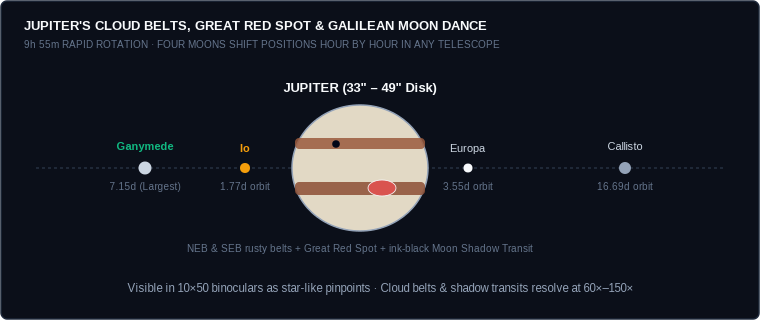
- Example on Jupiter: Jupiter's North/South Equatorial Belts and Great Red Spot are rich in reddish-ochre chromophores, while its Equatorial Zone is cream-white. Thread on a #80A Medium Blue filter: white zones pass brightly, while reddish-brown belts absorb blue light and turn high-contrast slate-charcoal!
- Example on Mars: Martian deserts reflect bright orange-red sunlight, whereas volcanic basalt plains like Syrtis Major have neutral/bluish-grey reflectivity. Thread on a #21 Orange or #23A Light Red filter: bright orange deserts blaze while Syrtis Major darkens starkly—and bluish atmospheric haze scatters away!
Master Wratten Planetary Filter Reference Table
| Wratten Code & Color | Transmission % | Min Aperture | Primary Planetary Enhancements |
|---|---|---|---|
| #80A Medium Blue | ~30% | 80mm+ | #1 Universal Filter: Sharpens Jupiter's belts, festoons & Great Red Spot; highlights Martian white polar clouds/hoods; tames Venus glare |
| #82A Pale Light Blue | ~73% | 60mm+ | Subtle, gentle contrast boost on Jupiter, Saturn & the Moon without dimming small 70mm–90mm beginner scopes! |
| #12 Yellow / #8 Light Yellow | ~74% – 83% | 70mm+ | Enhances Saturn's pale temperate belts; cuts purple chromatic halo fringes on fast achromatic refractors! |
| #21 Orange | ~46% | 114mm+ | #1 Mars Surface Filter: Penetrates Martian haze to etch Syrtis Major & Mare Acidalium; boosts twilight contrast on Mercury & Venus against blue sky! |
| #23A Light Red / #25 Red | 25% / 14% | 150mm+ (6"+) | Maximum Martian surface contrast near opposition in 6"–12" reflectors (too dim for small scopes) |
| #56 Light Green / #11 Yellow-Green | ~53% – 78% | 114mm+ | Darkens both red (GRS) and blue (festoons) simultaneously on Jupiter; sharpens edges of Martian polar ice caps |
| #47 Deep Violet | ~3% | 203mm+ (8"+) | Specialist filter exclusively for glimpsing subtle upper-deck UV cloud shadings on dazzling Venus in large mirrors |
Specialized Upgrades: Baader Moon & Skyglow (Neodymium) & ADCs
If you dislike how traditional Wratten filters tint the entire planet pure blue or pure orange, two modern optical innovations preserve natural planetary colors:
- Neodymium "Moon & Skyglow" Contrast Filter: Doped rare-earth neodymium glass surgically notches out muddy yellow `580–595 nm` wavelengths between green and red while leaving natural white balance intact—making Jupiter's salmon GRS and cinnamon belts pop simultaneously without an artificial color cast!
- Atmospheric Dispersion Corrector (`ADC`): When Saturn, Jupiter, or Mars culminates below `30°` altitude from your latitude, an ADC inserts two counter-rotating thin wedge prisms ahead of your eyepiece to cancel Earth's atmospheric rainbow dispersion completely—restoring overhead-style crispness even at `20°` elevation!
Frequently Asked Questions
Why shouldn't I stack two color filters together?
Unless you are combining a Variable Polarizer pair designed to work together, stacking dyed Wratten glass filters multiplies light losses and adds four extra air-glass surfaces that risk ghost reflections on bright planets.
Can a #8 or #12 Yellow ('Fringe Killer') filter fix purple halos in my budget refractor?
Yes—remarkably well! Two-element achromatic refractors leave unfocused deep-violet light (`400–430 nm`) blooming as a purple ring around Venus, Jupiter, and lunar crater rims. A #8 Light Yellow or dedicated Semi-APO/Fringe-Killer filter trims that unfocused violet tail cleanly for noticeably sharper limb edges.
Do color filters help see Uranus or Neptune?
No—Uranus and Neptune are tiny, relatively faint disks whose natural cyan and ocean-blue methane hues are their best visual feature! View both ice giants completely unfiltered.
Wait—is a 'Moon Filter' safe for looking at a Solar Eclipse?
NEVER! A Moon filter blocks 75%–87% of light, whereas a certified ISO 12312-2 front-aperture Solar Filter blocks **99.999% (Optical Density 5.0)** of light and infrared heat BEFORE it enters the telescope! Looking at the Sun with a Moon filter causes instant, permanent blindness.
How should I store eyepiece filters against dust and fungus?
Keep each filter snapped inside its clear plastic clamshell box inside a dry pouch with a small rechargeble silica-gel packet—never drop bare filters loose into pockets where keys scratch soft anti-reflective coatings.