The Complete Barlow Lens Guide: Doubling Zoom Without Losing Eye Relief
- Named after 19th-century optical engineer Peter Barlow, a Barlow lens inserts a diverging (negative) lens element just ahead of your eyepiece to double (2×) or triple (3×) your telescope's effective focal length.
- The #1 visual benefit of a quality 2× Barlow: pairing a comfortable 15mm Plössl with a 2× Barlow delivers 7.5mm high-power zoom while keeping the 15mm lens's generous 11mm eye relief!
- Throw away hollow, single-element plastic '3× Barlow' tubes bundled free with budget department-store scopes—upgrade to a multi-coated 2-element achromatic or 3/4-element telecentric Barlow.
- Choose eyepiece millimeter steps carefully (for example, 25mm + 9mm + 2× Barlow = 25, 12.5, 9, and 4.5mm) so your Barlow doesn't merely duplicate eyepieces you already own!
Optical Physics: How a Negative Diverging Lens Stretches Focal Length
In 1833, English mathematician and physicist Peter Barlow discovered that placing a cemented concave (diverging) flint-and-crown lens group just inside the converging cone of starlight ahead of a telescope's focal plane gently narrows the angle of the light rays. To your eyepiece sitting at the top of the Barlow barrel, that shallower light cone looks identical to light arriving from a telescope tube twice (or three times) as physical long!
- In an `f/5` reflector (`D = 130mm, F = 650mm`), inserting a 2× Barlow turns the optical system into an effective `f/10` (`F = 1,300mm`) system—instantly doubling the magnification of any 1.25-inch eyepiece dropped inside it (`20mm` acts like `10mm`; `12mm` acts like `6mm`).
- Bonus Edge Sharpness on Budget Eyepieces: Simple 4-element Plössl or Erfle eyepieces often show off-axis astigmatism at the outer edges when fed steep `f/4.5` or `f/5` light cones. Because a 2× Barlow flattens that steep `f/5` cone into a gentle `f/10` cone before it ever enters the eyepiece, stars often look noticeably sharper right out to the field stop!
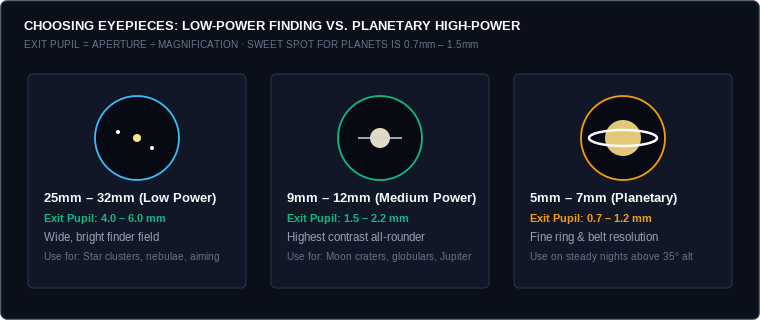
The Eye-Relief Superpower (Why Plössl Owners Love 2× Barlows)
Ask beginners why someone buys a Barlow and they say: "To save money buying half as many eyepieces." Ask an experienced visual observer and you hear an optical secret: preserving long eye relief at planetary magnifications!
As explained in our Telescope Eyepieces Guide, a bare `6mm` Plössl has a tiny peephole lens and barely `4 mm` of eye relief, forcing your eyelashes against cold glass. Drop a comfortable `12mm` or `15mm` Plössl (with a wide glass window and `9–11 mm` of eye relief) into a multi-coated 2× Barlow, and you get exact `6mm` or `7.5mm` planetary magnification while keeping 100% of the longer eyepiece's comfortable eye relief—in fact, standard diverging Barlows push the exit pupil slightly further back (`+1 to +2 mm` extra relief)!
Fun Bonus ("1.5× Mode"): On many modular metal 2× achromatic Barlows, the bottom black cell holding the glass lens unscrews cleanly on standard `1.25"` filter threads! Screwing just that tiny lens cell directly onto the bottom nosepiece of your eyepiece shortens the spacing distance (`M = 1 + d / f_barlow`), giving a super-handy ~1.5× magnification boost (`10mm` becomes `~6.7mm`) alongside full `2.0×` mode when placed back inside its barrel!
Shorty Barlows vs. Long Barlows vs. Telecentric Focal Extenders
| Barlow Architecture | Optics | Best Use Case & Caveats |
|---|---|---|
| Kit Plastic "3× Barlow" | 1 Uncoated Plastic/Glass Lens | Avoid completely: Introduces heavy purple/yellow chromatic fringes, internal flare, and pushes cheap scopes past `2× Aperture` blur limits |
| 2-Element Achromatic "Shorty" 2× | Cemented Doublet (FMC) | Compact (`~70mm` long) so it never hits the mirror inside a 90° star diagonal! Slight vignetting only on ultra-long `32mm` eyepieces; unbeatable $30–$50 value |
| 3-Element "APO" Barlow 2× | Air-Spaced / Triplet Group | Excellent color correction on fast `f/5` refractors and reflectors with virtually zero perceptible light loss (`>98%` transmission) |
| 4-Element Telecentric (Powermate / Focal Extender) | Negative Doublet + Positive Field Doublet | Gold standard: keeps emerging rays parallel rather than diverging—zero vignetting on wide eyepieces, constant amplification regardless of camera spacing |
Avoiding the "Duplicate Magnification" Trap When Building Your Kit
Look closely at what happens if your telescope came with `20mm` and `10mm` eyepieces and you buy a `2× Barlow`:
- Bad Overlapping Math: `20mm ÷ 2 = 10mm`—which duplicates the `10mm` lens already sitting in your pocket! Instead of four useful powers, you only got three (`20mm`, `10mm`, and `5mm`).
- Smart Staggered Math: Stagger your eyepiece focal lengths so halving them lands right in the gaps! For example, pairing `25mm` + `9mm` + a `2× Barlow` yields four evenly stepped effective focal lengths: `25mm` (finder) → `12.5mm` (clusters) → `9mm` (lunar/medium) → `4.5mm` (steady-night high planetary)!
Why High-Speed Planetary Photographers Rely on Barlows
Even astronomers who switch to dedicated fixed-focal-length planetary eyepieces for visual stargazing always keep a crisp 2× or 3× Barlow in their case for lunar & planetary CMOS imaging. Modern planetary camera sensors have tiny `2.0 µm to 2.9 µm` pixels; by the Nyquist sampling theorem, resolving every fraction of an arcsecond your mirror collects requires operating around **`f/15` to `f/20`** (`~5× pixel size in microns`). Dropping a 3× Barlow onto an `f/6` Dobsonian or a 2× Barlow onto an `f/10` SCT scales Saturn and Jupiter onto hundreds of crisp sensor pixels for "lucky imaging" video stacking!
Frequently Asked Questions
Does adding extra Barlow glass dim or degrade planetary contrast?
With an old uncoated plastic Barlow, yes—dramatically! With a modern Fully Multi-Coated (FMC) 2-element achromatic or 4-element telecentric Barlow, light transmission exceeds 98%–99% per group; side-by-side blind tests routinely show zero visible loss compared to standalone multi-element planetary eyepieces (many of which literally have a built-in Smyth/Barlow group inside their lower barrel anyway!).
Can you stack two 2x Barlows together to get 4x magnification?
Technically yes, physically and visually it's a bad idea for visual viewing: stacking two barrels creates a heavy, wobbly tower hanging off your focuser and almost always pushes magnification far past your telescope's sharp 2x-aperture limit into blurry empty zoom.
Should a Barlow go BEFORE or AFTER my 90-degree mirror star diagonal on a refractor?
Almost always insert the Barlow AFTER the diagonal (meaning: Telescope → 90° Diagonal → Barlow → Eyepiece). Putting a standard diverging Barlow ahead of the diagonal increases the throw distance `d`, jumping its factor from 2.0x up to ~2.8x–3.2x and sometimes requiring extra inward focuser travel.
Why won't my telescope reach focus when I insert a Barlow lens?
Most Barlows shift the focal point slightly inward or outward by 5–15 mm. Check that the eyepiece is seated cleanly all the way down against the Barlow's shoulder, turn the focus knob slowly through its full travel, and on Dobsonians make sure no extra 35mm extension adapter is blocking inward travel.
Should I buy a 2x Barlow or a 3x Barlow?
For 95% of visual stargazers, a 2x Barlow is vastly more versatile. A 3x Barlow jumps too aggressively on medium eyepieces (turning a 10mm straight into an extreme 3.3mm that blurs on average nights) and is mainly useful on ultra-fast f/4 imaging Newtonians.