Astronomical Seeing vs. Transparency: Reading the Invisible Ocean Overhead
- Transparency measures how clear and dust/cloud-free the air is (critical for faint galaxies and nebulae); Seeing measures how calm and steady the air's temperature layers are (critical for high-power planets, the Moon, and double stars).
- Ironically, Seeing and Transparency are frequently opposites! Crisp, crystal-clear nights right behind a winter cold front often have ferocious jet-stream turbulence that boils planets, while slightly hazy, stagnant summer high-pressure nights deliver unforgettable 250× razor-sharp Saturn views!
- You can diagnose tonight's Seeing in 3 seconds with your naked eyes: fierce star twinkling halfway up the sky means poor seeing; calm stars up to 25° mean steady planetary air.
- Eliminate local 'self-inflicted bad seeing' by observing above 35° altitude, cooling your telescope for 30 minutes, and steering clear of sun-heated roofs.
The Two Independent Weather Metrics Every Astronomer Tracks
When you observe the cosmos from Earth's surface, you are peering upward from the bottom of a turbulent, 100-kilometer-deep ocean of nitrogen, oxygen, and water vapor. Standard smartphone weather apps only report whether clouds or rain are coming—completely missing why two "100% cloudless" nights can behave like night and day at `180×` magnification! Experienced astronomers split clear-sky quality into two completely separate variables:
| Atmospheric Property | What It Physically Measures | Governs Which Targets? | Quick Naked-Eye Clue |
|---|---|---|---|
| Sky Transparency (1/5 to 5/5) | Absence of suspended water vapor, smog, dust, wildfire smoke, and invisible high cirrus ice crystals | Deep-Sky Contrast: Galaxies, nebulae, comets, Milky Way dark lanes (at low/medium power) | Deep jet-black/indigo sky right up to bright stars with zero milky halo around the Moon or Jupiter |
| Astronomical Seeing (Arcseconds / I–V) | Laminar steadiness of air refractive index across ground boundary layers and the 10-km jet stream | High-Power Resolution: Saturn's Cassini gap, Jupiter's GRS, Mars, lunar rilles, tight double stars | How rapidly stars twinkle (scintillate) at 30°–50° altitude |
Why Cold Crystal-Clear Nights Boil While Hazy Nights Freeze Sharp
Why do beginners frequently step outside on a sparkling, bone-dry winter evening right after a cold front sweeps away clouds—when the Milky Way blazes overhead—point at Jupiter, and watch the planet seethe like boiling soup?
- Post-Cold-Front Transparency Win / Seeing Loss: Passing cold fronts scrub dust and moisture out of the troposphere (`5/5 Transparency`—drop everything and hunt galaxies at `60×`!), but right overhead at 9 to 12 kilometers altitude sits a 200+ km/h polar jet stream shearing cold polar air violently against warmer air below! Mixing air pockets of different temperatures creates millions of shifting micro-lenses (`3.0"–4.0"` seeing blur) that shred high-power planetary waveforms.
- Stagnant Summer / Monsoon-Break High Pressure (Seeing Win!): Conversely, when a warm, sluggish dome of high atmospheric pressure parks over your region for three days, slight haze or humidity may turn the sky pale (`2/5 Transparency`—skip faint galaxies!), yet wind shear from ground to tropopause drops near zero! Under those stagnant summer domes, Saturn hangs in the eyepiece at `240×` like a still steel engraving!
The Pickering & Antoniadi Scales: Rating Seeing in Your Eyepiece
Professional observatories quote seeing by the Full Width at Half Maximum (FWHM) in arcseconds (`0.5"` atop Mauna Kea or Atacama; `1.2"–2.5"` in typical sea-level suburbs). Amateur planetary observers log sessions using the classic five-point Antoniadi Scale (Roman numerals `I` = perfect to `V` = awful) or 10-point Pickering Scale:
- Antoniadi I (Sub-Arcsecond · Pickering 8–10): Unforgettable 5-times-a-year stillness. Stars at `250×` show motionless pinpoints ringed by unbroken diffraction circles; fine white ovals and festoons cover Jupiter continuously.
- Antoniadi II – III (Good to Moderate · Pickering 5–7): The workhorse nights! The planet gently undulates for 4 or 5 seconds, then suddenly snaps crystal-sharp for 2 to 3 seconds ("lucky moments") as a calm laminar air cell drifts overhead. Keep your eye relaxed at the eyepiece for 5 continuous minutes to drink in those fleeting moments!
- Antoniadi IV – V (Poor · Pickering 1–4): Rapid high-frequency jet-stream shimmer turns planetary limbs fuzzy above `100×`. Switch to low-power wide-field star clusters (`35×–65×`) and enjoy the night stress-free!
How Altitude Air Mass Multiplies Turbulence Near the Horizon
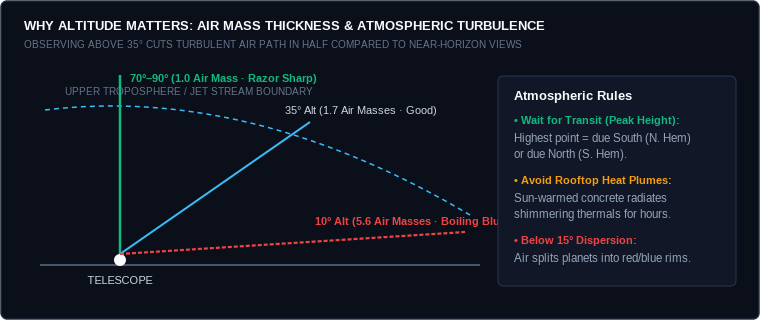
Even on an Antoniadi I dream night, aiming at a planet sitting `10°` above the horizon forces starlight diagonally through 5.6× more air (`Air Mass ≈ csc(10°)`) than straight overhead! Worse yet, differential refraction bends blue light slightly higher than red light, smearing Saturn and Venus into tiny vertical spectra below `22°`. Always check the All-Night Height Graph on our Live Sky Planner and schedule high-power planetary sessions within `±90 minutes` of each planet's highest meridian transit.
Five Backyard Microclimate Rules for Sub-Arcsecond Planetary Views
Half of all "bad seeing" actually originates within 15 meters of your own telescope! Eliminate local boundary-layer turbulence with five field-tested habits:
- Set Up on Grass, Soil, or Wood Decks Instead of Concrete/Asphalt: Vegetation cools to ambient air temperature within 20 minutes after sunset, whereas thick concrete terraces radiate convecting warm plumes past midnight. (On apartment balconies, hosing or mopping sun-baked tiles lightly an hour before dusk noticeably speeds cooling!)
- Mind Neighboring Roofs & Vents: Check what lies directly along your telescope's line of sight—a planet sitting right above a neighbor's warm tile roof, kitchen exhaust, or boiler flue will boil fiercely until Earth's rotation carries it clear.
- Pre-Cool Your Optical Tube (30–45 Minutes): Internal mirror plumes mimic terrible atmospheric seeing; fans on 8"+ Dobsonians cut cooldown time in half.
- Watch Pre-Dawn & Twilight Calm Windows: Right around sunset—and during the two quiet hours before dawn when ground and air temperatures reach thermal equilibrium—local boundary-layer winds frequently drop dead calm!
- Keep Body Heat Downwind of Open Tube Mouths: Standing right underneath the open front ring of a Dobsonian sends a 37°C human thermal plume curling straight across incoming starlight!
Frequently Asked Questions
How does PlanetsTonight.com calculate tonight's Seeing Score?
Our weather engine blends upper-tropospheric wind shear, boundary-layer temperature gradients, cloud fraction, and relative humidity from MET Norway Locationforecast 2.0 and 7Timer! ASTRO numerical grids across your local dark hours—shown right on the homepage Stargazing Score card!
Why do coastal beaches and islands often have remarkably steady planetary seeing?
Oceans change temperature very slowly between day and night, creating smooth, laminar onshore breezes free of jagged mountain lee-waves and hot inland thermal plumes! That is why island peaks (La Palma, Hawaii) and coastal observatories (like Florida Winter Star Party) are legendary among planetary observers.
Why is planetary seeing often rougher near steep mountain ranges?
Unless you are standing at the very highest windward summit above the inversion layer, winds blowing over mountain ridges tumble into turbulent lee-side rotors and cold-air valley drainage currents ('katabatic winds') that churn starlight down in adjacent foothills.
Should I use a bigger or smaller telescope on a night of poor seeing?
Contrary to an old myth that large apertures are 'hurt worse' by bad seeing, an 8-inch telescope stopped down—or simply run at the EXACT SAME 110x magnification as an 80mm refractor—always matches or beats the small scope during brief 1-second calm pockets, provided the 8-inch mirror has fully cooled down to ambient temperature!
Can smoke from distant wildfires actually coincide with good planetary seeing?
Surprisingly, yes! Thin upper-level smoke ruins deep-sky transparency for galaxies and tints planets warm amber-gold, yet the temperature inversion layer trapping that smoke often suppresses vertical convection so strongly that Saturn and the Moon look astonishingly steady at 200x.