Seasonal Night-Sky Stargazing Calendar: What Rules the Sky Every Quarter
- Because Earth moves ~1° eastward around the Sun every day, the stars rise 4 minutes earlier each evening (2 hours earlier per month)—rotating a brand-new quadrant of the universe into your 9:00 PM window every three months!
- December–February showcases bright nearby spiral-arm jewels (Orion, Taurus, Gemini, Sirius); March–May looks straight out of our galaxy into the Virgo/Leo 'Realm of Galaxies'; June–August gazes inward into the rich Milky Way core (Sagittarius & Scorpius); September–November frames our neighbor galaxy Andromeda!
- Unlike fixed seasonal constellations, the eight Solar System planets wander independently along the Zodiac—check our live tracker pages for tonight's exact planetary positions.
- Want a sneak peek at next season's constellations tonight? Simply stay up (or wake up) at 3:00 AM!
The 4-Minutes-Per-Day Clockwork Behind Changing Seasons
Why is mighty Orion high overhead at 9:30 PM in January, yet completely missing from the 9:30 PM July sky? A solar clock day lasts `24 hours, 00 minutes`, whereas Earth completes one true `360°` spin relative to distant stars in **23 hours, 56 minutes, and 4 seconds** (a *sidereal day*). Those missing **3 minutes and 56 seconds per day** add up to precisely **2 hours per month** (`24 hours over 12 months`)!
That simple orbital geometry hands you a cool superpower: if it is October and you can't wait until January to view the Orion Nebula, you don't have to wait three months—just step outside **six hours later (at 3:00 AM instead of 9:00 PM)** and Earth's rotation has already turned your backyard around to face January's stars!
December – February: Orion's Winter/Cool-Season Treasure Chest
During Northern Winter / Southern Summer evenings, Earth's night side faces outward along our local **Orion-Cygnus Spiral Arm**, packing more blazing 1st-magnitude stars into one patch of sky than any other quarter of the year (the famous *Winter Hexagon*):
- Signature Constellations: Orion, Taurus, Canis Major, Gemini, Auriga, and Canis Minor.
- Naked-Eye & Binocular Highlights: Blazing blue-white Sirius (`mag −1.46`), red supergiant Betelgeuse vs blue supergiant Rigel, the V-shaped Hyades, and the glittering Pleiades (M45).
- Prime Telescope Showpieces: The Great Orion Nebula (M42) & Trapezium quadruple star, star clusters M35 (Gemini) and M36/M37/M38 (Auriga), multiple star Castor, plus December's blockbuster 120-per-hour Geminid Meteor Shower!
March – May: "Galaxy Season" Looking Out into Intergalactic Space
Come April evenings, the bright dusty band of our Milky Way lies flat around the horizon—opening an unobstructed, dust-free North Galactic Pole window straight out into deep intergalactic space! Telescope owners call March through May **"Galaxy Season"**:
- Signature Constellations: Leo the Lion (the backwards question-mark "Sickle"), Ursa Major overhead, Boötes (orange Arcturus), Virgo (blue Spica), Corvus, and Cancer.
- Naked-Eye & Binocular Highlights: The Beehive Cluster (M44) in Cancer, Coma Star Cluster (Melotte 111), and Northern Hemisphere's highest evening Mercury elongations!
- Prime Telescope Showpieces: The Leo Triplet (three spiral galaxies in one wide eyepiece!), M81 & M82 in Ursa Major, M51 Whirlpool Galaxy, M104 Sombrero Galaxy, Markarian's Chain of Virgo Cluster galaxies (`55 million light-years` away!), and sparkling globular clusters M3 and M5.
June – August: Gazing Into the Heart of the Milky Way Core
Six months after January, Earth sits on the opposite side of the Sun—aiming our midnight sky straight inward `26,000 light-years` toward the supermassive black hole (`Sagittarius A*`) and dense star clouds at the Galactic Center! (From India and Southeast Asia, look for crisp post-rain break nights or pre-monsoon late-night May previews; from Southern Hemisphere latitudes, Sagittarius and Scorpius pass breathtakingly straight overhead at the zenith!):
- Signature Constellations: Scorpius, Sagittarius ("The Teapot"), Cygnus the Swan, Lyra (Vega), Aquila (Altair), Hercules, and Ophiuchus.
- Naked-Eye & Binocular Highlights: Sweeping up from the Teapot spout through Scutum and Cygnus in 10×50 binoculars reveals endless star clouds, dark Barnard dust lanes, and August's beloved Perseid Meteor Shower.
- Prime Telescope Showpieces: Lagoon (M8), Trifid (M20), Swan (M17), and Eagle (M16) nebulae; Ring Nebula (M57) and Dumbbell (M27); gold-and-sapphire double star Albireo; and flagship globulars M13, M22, and M4—plus stagnant high-pressure summer air delivering razor-sharp planetary seeing!
September – November: Pegasus, Perseus & The Andromeda Neighbor
Crisp autumn evenings bring comfortable hours, earlier sunsets (`dark by 7:00 PM!`), and our view along the outer Perseus Arm toward our Local Group neighbors:
- Signature Constellations: The Great Square of Pegasus, Andromeda, Cassiopeia, Perseus, Pisces, Cetus, and Capricornus.
- Prime Telescope & Binocular Showpieces: Our majestic spiral neighbor Andromeda Galaxy (M31) and face-on Triangulum Galaxy (M33), the glittering Perseus Double Cluster, variable "Demon Star" Algol (winking noticeably in brightness every `2.87 days` as an eclipsing binary!), Owl/ET Cluster (`NGC 457`), plus prime autumn evening placement in 2026–2027 for Saturn, Neptune, and Uranus!
How Wandering Planetary Cycles Overlay Fixed Star Seasons
| Planet | Opposition / Apparition Interval | How Quickly Its Season Shifts Each Year |
|---|---|---|
| Saturn | Every 378 Days (~12.4 Months) | Opposition shifts ~13 days later each calendar year (currently ruling Sept–Jan evenings) |
| Jupiter | Every 399 Days (~13.1 Months) | Advances roughly one Zodiac constellation eastward per year (~33 days later annually) |
| Mars | Every 780 Days (~26 Months) | Surges to brilliant close opposition only once every two years and two months |
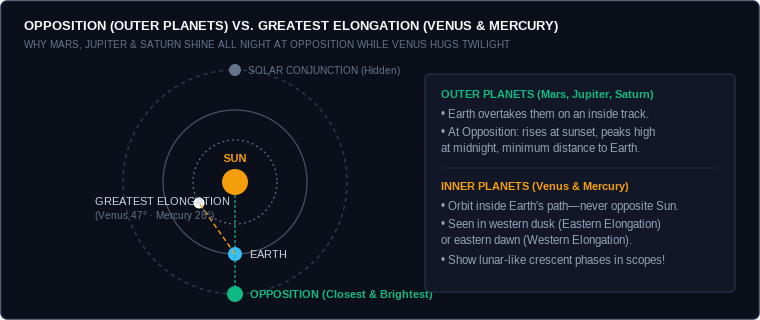
| Venus & Mercury | 584 Days (Venus) · 116 Days (Mercury) | Cycle briskly between western evening dusk and eastern morning dawn independent of background stars |
Frequently Asked Questions
Are the constellations completely different in the Southern Hemisphere (Australia, South Africa, Argentina)?
Equatorial and Zodiacal constellations—including Orion, Leo, Virgo, Scorpius, Sagittarius, Taurus, and Pegasus—are visible from BOTH hemispheres (though appearing upside-down in the south compared to northern charts!). Only the ~20°–35° circumpolar caps swap exclusively: Northern observers always keep the Big Dipper and Cassiopeia, while Southern observers enjoy Crux (Southern Cross), Centaurus, Carina, and the two naked-eye Magellanic Cloud dwarf galaxies!
Why do winter stars look brighter and crisper than summer stars?
Not because cold air magnifies light! It is pure galactic geography: in December–February evenings we happen to face a rich local cluster of young, massive blue-white supergiant stars (Rigel, Sirius, Procyon, Betelgeuse, Aldebaran, Capella) sitting just 8 to 800 light-years away in our local spiral arm, whereas spring evenings face empty intergalactic space.
Why does sunset happen so late in June at 50°N (London/Canada) that stargazing barely lasts 3 hours?
Above ~48.5°N latitude around the June Summer Solstice, Earth's 23.4° axial tilt keeps the Sun from ever sinking deeper than −18° below the northern horizon—meaning true 'Astronomical Darkness' disappears for several weeks of perpetual twilight! Fortunately, bright planets and the Moon remain completely unaffected by summer twilight.
Which season has the most comfortable weather + early darkness sweet spot?
October and November evenings (and March–April in both hemispheres) are widely beloved: sunset arrives early enough for 7:30 PM family sessions before bedtime, mosquitoes vanish, and brutal deep-winter sub-zero temperatures haven't arrived yet.
Where can I check exact tonight rise times for both planets and seasonal Messier targets?
Right on our PlanetsTonight.com Live Sky Planner—select any date in our 8-Day Night Selector to plan weekend sessions with cloud and Moon glare scores included!