Meteor Showers Field Guide & Annual Calendar: How to Catch Maximum Shooting Stars
- Put your telescope and binoculars away for meteor showers! Shooting stars streak unpredictability across 90° of sky in half a second—your reclined naked eyes are the ultimate wide-angle meteor instrument.
- Observing between Midnight and Dawn typically delivers 2× to 3× more meteors per hour than 9:00 PM because Earth's rotation turns your backyard onto the forward 'windshield' plowing head-on into cosmic dust!
- Always check our Moon Phase tracker alongside shower peak dates: a dazzling Full Moon washes out 80% of faint meteors, whereas a New or Crescent Moon lets rural observers count 60–100+ Geminids or Perseids per hour.
- Don't stare straight at the shower's named constellation ('radiant')—look 40° to 60° to the side and high up (`50°–70°` altitude) to catch the longest dramatic luminous trails!
What Shooting Stars Really Are (Comet Dust & Asteroid Gravel)
Every clear night of the year, you can spot 4 to 8 random sporadic meteors per hour. On roughly a dozen predictable weeks each calendar year, however, Earth's orbital path intersects a dense ribbon of ancient debris shed along the orbit of a periodic comet (or, in December's famous Geminids, shed by rocky sun-grazing asteroid 3200 Phaethon!).
Amazingly, almost every brilliant shooting star you gasp at is caused by a particle no larger than a grain of coarse beach sand or a toasted sesame seed (`1 mm to 5 mm`, weighing less than a tenth of a gram)! What creates a dazzling streak visible from 150 kilometers away is sheer kinetic energy (`½mv²`): slamming into Earth's upper mesosphere (`80 to 110 km` altitude) at hypersonic speeds between 35,000 and 255,000 km/h (`11 to 71 km/s`) compresses and superheats air molecules ahead of the grain into a glowing plasma cylinder meters wide that vaporizes completely miles above your head. Larger pebble- or walnut-sized fragments blaze brighter than Venus (`magnitude −4` or brighter), earning the official title Fireball or exploding Bolide—sometimes leaving ghostly ionized smoke trains that twist in upper-atmosphere winds for 30 seconds in binoculars!
Master Annual Meteor Shower Calendar (January to December)
Meteor astronomers quote peak strength using Zenithal Hourly Rate (`ZHR`)—the theoretical count one sharp-eyed observer would log under pristine Bortle Class 1 skies with the radiant straight overhead. Use the realistic table below year after year:
| Meteor Shower | Active Window & Peak Night | Dark-Sky ZHR | Entry Speed | Parent Body & Visual Character |
|---|---|---|---|---|
| Quadrantids | Dec 28 – Jan 12 Peak: Jan 3–4 |
80 – 110 | 41 km/s (Med) | Asteroid 2003 EH1 · Sharp 6-hour peak before dawn in northern Bootes; rich blue fireballs |
| Lyrids | Apr 14 – Apr 30 Peak: Apr 21–22 |
18 | 49 km/s (Fast) | Comet Thatcher · Reliable spring warmup near bright star Vega; occasional surprise surges |
| Eta Aquariids | Apr 19 – May 28 Peak: May 5–6 |
50 | 66 km/s (Swift) | Halley's Comet! #1 shower for Tropics & Southern Hemisphere; long skimming pre-dawn earthgrazers |
| Southern Delta Aquariids | Jul 12 – Aug 23 Peak: Jul 29–30 |
25 | 41 km/s (Med) | Comet Marsden/Kracht · Steady warm-night trickle blending right into early August Perseids |
| Perseids | Jul 17 – Aug 24 Peak: Aug 12–13 |
90 – 100 | 59 km/s (Swift) | Comet Swift-Tuttle · Beloved summer classic; colorful emerald/violet streaks & glowing persistent trains |
| Orionids | Oct 2 – Nov 7 Peak: Oct 21–22 |
20 – 25 | 66 km/s (Swift) | Halley's Comet (inbound crossing!) · Fast, fine needles darting away from Orion's club after midnight |
| Taurids (S & N) | Oct 10 – Nov 20 Broad: Nov 4–12 |
5 – 10 | 28 km/s (Slow) | Comet Encke · Low total rate, yet famous for slow, dramatic orange "Halloween Fireballs"! |
| Leonids | Nov 6 – Nov 30 Peak: Nov 17–18 |
15 | 71 km/s (Fastest!) | Comet Tempel-Tuttle · Fastest collisions of all (`255,000 km/h` head-on!); historic 33-year storm pedigree |
| Geminids | Dec 4 – Dec 20 Peak: Dec 13–14 |
120 – 150 | 35 km/s (Med-Slow) | #1 Shower of the Year! Dense rocky grit from 3200 Phaethon; starts strong by 10 PM & peaks all night! |
| Ursids | Dec 17 – Dec 26 Peak: Dec 21–22 |
10 | 33 km/s (Slow) | Comet Tuttle · Quiet northern solstice cap near Ursa Minor's bowl |
The "Car Windshield" Effect: Why Post-Midnight Hours Win
Why do almost all meteor guides tell you to set an alarm for 1:30 AM to 4:30 AM local time (with the handy exception of December's Geminids, whose Gemini radiant rises early in the evening)?
Picture driving a car through a gentle snowfall: the front windshield slams head-on into vastly more snowflakes per minute than the rear back window, where only fast-falling flakes manage to catch up from behind! As Earth hurtles around the Sun at `107,000 km/h`:
- 6:00 PM to 11:00 PM (Earth's "Rear Window"): Your city sits on the trailing hemisphere of Earth—meteors must overtake Earth from behind, producing fewer (though occasionally ultra-long, slow "earthgrazer") streaks.
- Midnight to Dawn (Earth's "Front Windshield"): Earth's spin rotates your lawn directly into our orbital direction of travel, sweeping up dust streams head-on at combined speeds up to `71 km/s` and doubling or tripling visible flashes!
Where to Look in the Sky (Radiant Geometry Explained)
Every meteor shower takes its name from the constellation containing its Radiant—for example, Perseus for the Perseids or Gemini for the Geminids. Just like parallel railroad tracks appearing to converge on the distant horizon through perspective, parallel meteoroid particles entering our atmosphere appear to shoot outward in all directions from that radiant point.
Crucial Mistake to Avoid: Do not stare dead-center at Perseus or Gemini! Meteors plunging almost straight toward your face right at the radiant look foreshortened into stubby `1°` flashes. Instead, recline on a camp mat or deck lounger, keep 25 minutes of unbroken dark adaptation (phones tucked in pockets!), and relax your gaze 40° to 60° away from the radiant around 55°–70° altitude—where meteors slice sideways across the sky in sweeping `15°–30°` arcs!
How Moonlight & Bortle Skyglow Impact Real Hourly Counts
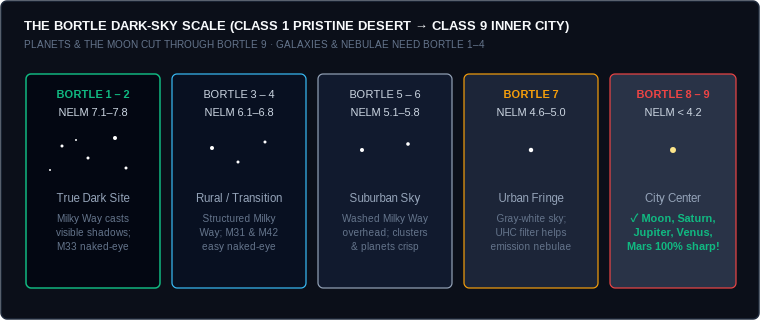
While bright −2 magnitude fireballs punch right through suburban skies, roughly 75% of shower meteors shine between magnitudes +2.5 and +5.0. If peak night falls near a Full Moon or inside a Bortle 8 city, you might count 6 to 12 bright Perseids per hour instead of 80! Whenever a waxing Moon sets at midnight (or a waning Moon rises at 2:00 AM), schedule your session strictly inside the Moon-free dark window—and drive just 35 minutes outside town to an open rural field for an unforgettable cosmic show.
Frequently Asked Questions
Can a meteor from a meteor shower hit the ground as a meteorite?
Almost never from cometary meteor showers! Fragile, icy-porous cometary dust grains (Perseids, Orionids, Leonids) vaporize completely 75 to 100 km above the ground. Meteorites recovered on Earth almost always originate from sporadic dense stony or iron asteroidal fragments traveling at slower relative speeds (<20 km/s).
Why do some Perseid and Geminid meteors glow bright green?
That vivid emerald-green color (around 557.7 nm and 518 nm) comes from excited oxygen atoms in Earth's upper atmosphere and vaporizing magnesium/nickel inside the meteoroid grain itself! Faster showers excite atmospheric oxygen more intensely, while sodium-rich grains glow warm golden-yellow.
Do I need to check exact minute-by-minute forecasts like an eclipse?
Unlike a 4-minute solar eclipse, major showers like the Perseids and Geminids stay elevated for 2 to 4 consecutive nights around peak! If clouds roll in on peak night, watching one night before peak still delivers 40% to 65% of peak rates.
Can I photograph meteors with a DSLR, mirrorless, or smartphone?
Yes—put a wide-angle lens (14mm–24mm f/1.8–f/2.8, or a tripod-mounted phone in continuous 20-second RAW interval timer mode) pointed 45° from the radiant and let it shoot hundreds of back-to-back exposures for two hours so bright fireballs wander right across open shutters!
Are meteor showers safe for astronauts on the International Space Station?
Orbital Whipple shields made of multi-layer Kevlar, Nextel ceramic fabric, and aluminum protect pressurized ISS modules by shattering sub-centimeter hypervelocity grains into harmless dispersed vapor clouds upon outer-bumper impact.